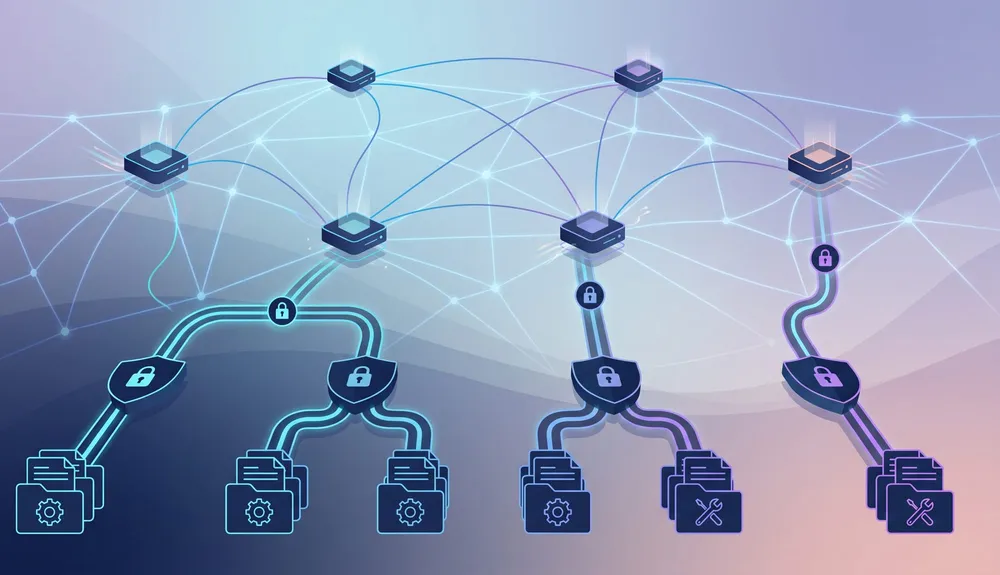
A2A vs MCP: The New Standards Making AI Agents Work Together
The conversation about business AI is moving beyond which model gives the best answer. The harder question is how different agents, models and business systems will work together without turning every integration into a one-off project.
Two open standards are becoming important in that discussion: the Model Context Protocol (MCP) and the Agent2Agent Protocol (A2A).
The short version is simple: MCP helps an AI application connect to tools and data. A2A helps independent AI agents communicate and collaborate. They sit at different layers, which is why most organisations will not need to choose one over the other. A practical agent system may use MCP inside each agent and A2A between agents.
This distinction matters commercially. If access to your CRM, documents, databases and quoting systems is separated from the model provider, and if specialist agents can communicate through a shared protocol, you have more freedom to use OpenAI for one task, Claude or Gemini for another, a local model for sensitive work, and future providers where they offer a better fit.
That does not make an AI system completely free of lock-in. Prompts, embeddings, stored conversations, proprietary model features and operational tooling can still create switching costs. But open integration boundaries give businesses a much stronger starting position.
MCP and A2A Solve Different Problems
Think of the standards as two complementary connection layers in an AI system.
MCP Connects Systems
An AI application uses MCP to discover and call tools, retrieve resources and use approved workflows exposed by APIs, databases, documents and business platforms.
A2A Connects Agents
Independent agents use A2A to advertise capabilities, exchange messages, delegate tasks, track progress and return results without exposing their internal implementation.
Businesses Use Both
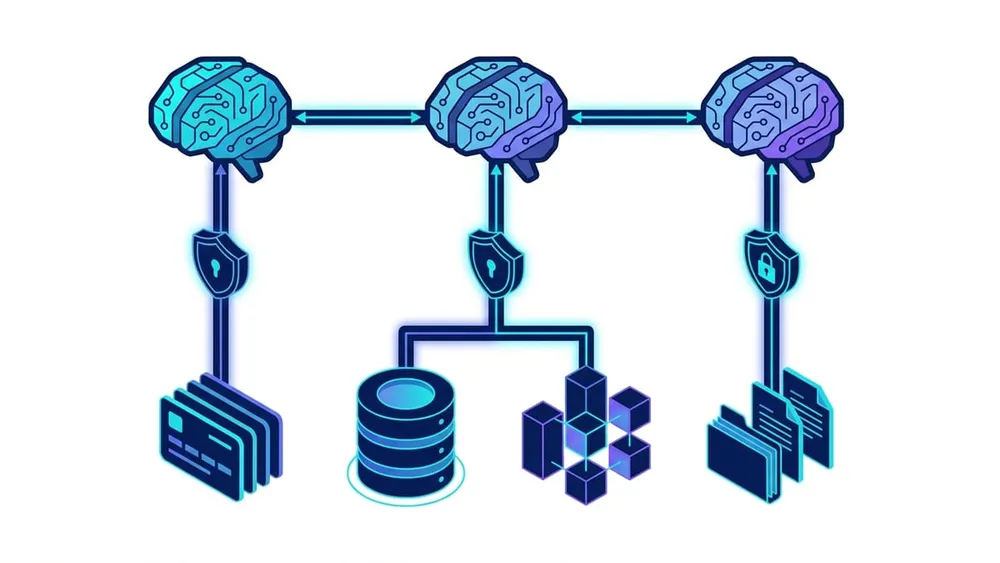
A2A can coordinate specialist agents while each agent uses MCP to reach the systems it needs. The model behind each agent can change independently.
What Is MCP?
Model Context Protocol is an open-source standard for connecting AI applications to external systems. It was introduced by Anthropic in November 2024 and is now governed as a project of the Agentic AI Foundation under the Linux Foundation.
The official MCP documentation describes three main server primitives:
- Resources provide contextual data, such as document content, files, records or database results.
- Tools let an AI application retrieve information or perform an action, such as finding a CRM contact, checking inventory or creating a draft quote.
- Prompts provide reusable interaction templates or workflows that users can select.
MCP uses a host-client-server architecture. The host is the AI application that manages permissions, consent and model integration. It creates an MCP client connection to each MCP server. The servers expose focused business capabilities while remaining separate from the model itself.
That separation is useful because the same CRM capability can potentially be used by different AI applications. Instead of writing a new CRM integration for every assistant or model provider, a team can expose a stable set of MCP tools such as find_customer, list_open_opportunities and create_quote_draft.
MCP connects more than APIs
For a business, the underlying MCP servers might provide controlled access to:
- CRM and customer service platforms
- ERP, inventory, pricing and order systems
- SQL databases and internal data services
- SharePoint, Google Drive and document repositories
- CMS, ecommerce and product information systems
- Calendars, email, ticketing and project tools
- Custom line-of-business applications
It is more accurate to say that an AI application or agent host supports MCP than to say a model alone supports it. A hosted model, a local model or a future provider can sit behind an application that implements the MCP client layer. OpenAI's current Responses API documentation, for example, supports remote MCP servers and approval controls, while other platforms provide their own MCP client implementations.
What MCP does not solve by itself
MCP is not a database, workflow engine or universal security policy. It standardises communication, but the host and server still need authentication, authorisation, least-privilege tools, audit logging and approval rules. A badly designed tool remains risky even when it uses an open protocol.
What Is A2A?
Agent2Agent Protocol is an open standard for communication and collaboration between independent AI agents. Google introduced A2A in April 2025 and later donated it to the Linux Foundation. By August 2026, the A2A project describes version 1.0 as its first stable, production-ready release.
A2A is designed for agents that may be built by different teams, use different frameworks, run in different environments or rely on different model providers. One agent does not need access to another agent's private memory, tools or source code. It only needs to understand the capability being offered and the protocol for requesting work.
Important A2A concepts include:
- Agent Cards describe an agent's identity, endpoint, capabilities, supported interfaces and authentication requirements.
- Messages carry instructions, context and responses between a client and a remote agent.
- Tasks represent stateful units of work that can move through a lifecycle.
- Artifacts are outputs produced by an agent, such as a document, structured record or file.
- Streaming, polling and webhooks support both immediate responses and long-running work.
A2A does not tell a team how to build the internal reasoning loop of an agent. It is not a replacement for an agent framework, and it does not dictate which model the agent must use. Its job is to provide a durable boundary through which independent agents can discover capabilities, delegate work and exchange results.
This makes A2A particularly relevant when agents cross application, department, supplier or organisational boundaries. A sales agent operated by one system could delegate a compliance check to a separate agent. A customer service agent could ask a logistics agent for a delivery status without knowing how the logistics agent obtains or calculates that information.
A2A vs MCP: What Is the Difference?
A2A and MCP are sometimes presented as competing standards, but the official A2A documentation is explicit: they are complementary.
| Question | MCP | A2A |
|---|---|---|
| What does it connect? | AI applications and agents to tools, data and workflows | Independent agents to other agents |
| What is the main purpose? | Expose usable context and actions through a standard interface | Discover capabilities, delegate tasks and exchange results |
| What sits behind the boundary? | An API, database, document source, business application or workflow | An autonomous or semi-autonomous agent with its own logic and tools |
| What is exchanged? | Tool definitions, resource content, prompt templates and tool results | Messages, tasks, status updates and artifacts |
| Does the other side need to reveal its internals? | No. The server exposes only its declared capabilities. | No. The agent can remain opaque behind its Agent Card and task interface. |
| Typical business example | Look up a customer record or create a draft in the quoting system | Ask a specialist quote agent to prepare a proposal |
A useful mental model is: MCP gives an agent hands and access to approved information. A2A gives agents a common language for working with one another.
A Practical Business Example: From Customer Request to Quote
Consider a business that receives a customer request through its website:
We need 250 customised units delivered to Sydney next month. Can you prepare a quote?
A multi-agent workflow could handle the request like this.
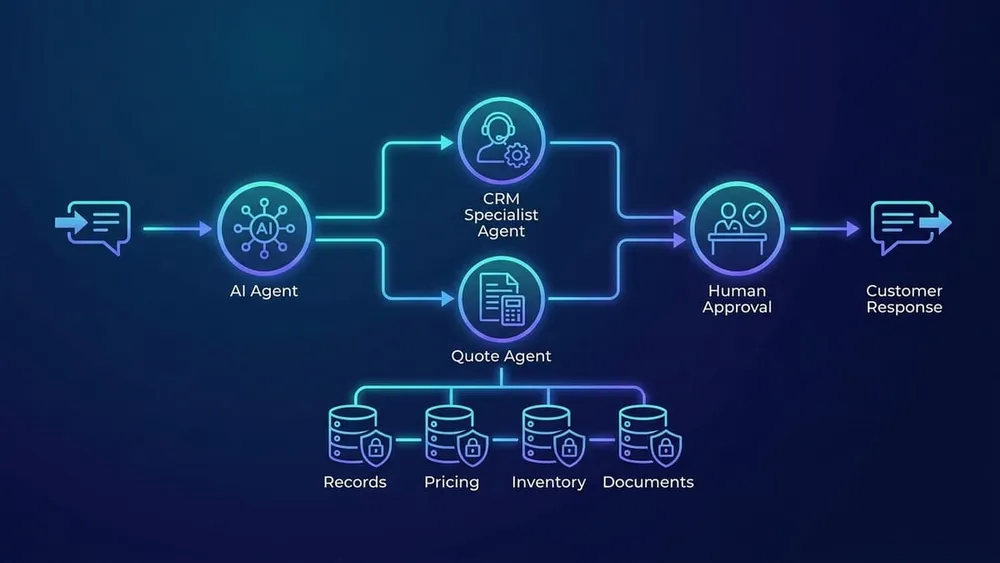
- An intake agent receives and structures the request. It identifies the customer, product, quantity, delivery location, timing and any missing information. It creates a traceable workflow record.
- The intake agent delegates a customer check through A2A. A separate CRM agent advertises that it can verify accounts and sales history. It receives the task without exposing its internal prompts or database credentials.
- The CRM agent uses MCP to access the CRM. Approved MCP tools retrieve the customer record, account status, negotiated discounts and open opportunities. The CRM agent returns a structured result through A2A.
- A quote agent receives the verified request and customer context through A2A. It specialises in pricing and proposal creation.
- The quote agent uses MCP to reach the underlying systems. It checks the ERP or product catalogue for current pricing, confirms stock or lead times, calculates delivery rules and creates a draft quote in the quoting platform.
- A human approves the commercial commitment. Discounts outside policy, unusual terms or the final customer-facing quote can require sales approval before anything is sent.
- The intake agent returns the outcome. It can send the customer a confirmation, provide an expected response time and update the CRM activity history.
In this example, A2A carries the delegation and results between agents. MCP provides controlled access to the CRM, ERP, catalogue and quote system.
Not every workflow needs multiple agents. If one application owns the whole process and the steps are tightly coupled, a single agent with several MCP tools may be simpler. A2A becomes valuable when specialist capabilities have independent ownership, separate security boundaries, different deployment cycles or a real need to work across platforms and organisations.
Why Open Standards Matter for Businesses
Open standards are not only a developer convenience. They affect procurement, integration cost and strategic flexibility.
Reuse integrations across AI applications
When a business capability is exposed through a well-designed MCP server, the integration investment is less tightly coupled to one assistant or model provider. A CRM connection can become a reusable platform capability instead of being rebuilt for each AI project.
Reduce the cost of switching
A provider change should ideally affect the model adapter, prompts and evaluations rather than the CRM, ERP and document integrations underneath the workflow. A2A can also let an organisation replace one specialist agent while preserving its published task contract.
Choose the best fit per workload
One provider may be stronger for complex reasoning, another may offer better price or latency for routine work, and a local model may be appropriate for a narrow, sensitive task. Standard boundaries make it easier to combine those choices.
Work across teams and suppliers
A2A is useful where one team should not need another team's source code or internal agent state. A capability can be offered through a documented agent contract, protected by normal enterprise identity, network and audit controls.
Avoid isolated agent platforms
Without shared protocols, each platform can become its own island of connectors, agent definitions and workflow state. The immediate demo may look fast, but every later integration or migration becomes more expensive.
However, open standards do not eliminate lock-in automatically. A system can still become dependent on provider-specific assistants, stored threads, vector stores, proprietary tool formats, prompt behaviour or evaluation features. The architecture around MCP and A2A matters just as much as adopting the protocols.
How to Architect AI Systems for Provider Flexibility
If a business wants the option to switch between OpenAI, Claude, Gemini, local models and future providers, it should design for replaceable model execution from the beginning.
1. Keep business workflows outside the model provider
The application should own workflow state, approval rules, retries, timeouts and error handling. Do not make a provider's conversation thread or agent console the only record of what happened. Store important state in systems the business controls.
2. Put model providers behind an internal gateway
Create a model interface or gateway that presents a small set of capabilities to the application: generate structured output, use tools, create embeddings, process images or stream responses. Implement provider adapters behind that interface.
Do not force every provider into an artificial lowest common denominator. Define a portable baseline and record optional capabilities, such as larger context windows, native document processing or specialised reasoning. The router can choose a provider only when a workload needs those features.
3. Make MCP the integration edge
Expose stable business capabilities through MCP servers or equivalent internal services rather than embedding vendor SDK calls throughout the application. Tool names and schemas should describe business intent, not the underlying vendor.
For example, prefer get_customer_pricing over run_sql_query. Narrow tools are easier to authorise, test, audit and reuse.
4. Use A2A for genuine agent boundaries
Publish an A2A interface when a capability is independently owned, separately deployed or needs to be used across frameworks or organisations. Avoid turning every function into an agent. Extra agent boundaries introduce network calls, failure modes, latency and governance work.
5. Keep prompts, schemas and policies portable
Version prompts, tool schemas, system policies and output contracts in your own repository or configuration service. Separate business instructions from provider-specific tuning. This makes it possible to run the same test set against multiple providers.
6. Own data and retrieval state
Keep authoritative documents, conversation records and workflow state in business-controlled stores. For embeddings, record the source content, chunking rules and embedding model so an index can be rebuilt if the provider changes. A vector database without reproducible source data is a hidden form of lock-in.
7. Centralise identity, secrets and observability
Use your own secret management, service identities, access policies, audit trail and telemetry across providers. Logs should correlate the customer request, A2A tasks, model calls, MCP tool calls, approvals and final outcome without exposing unnecessary sensitive content.
8. Build provider-switching into testing
Maintain contract tests for MCP tools and A2A endpoints, plus business evaluations for accuracy, latency, cost and safety. Run a representative test set against at least two viable model routes. A theoretical fallback that has never been tested is not a real fallback.
9. Keep critical business rules deterministic
Pricing limits, eligibility, permissions, tax calculations and approval thresholds should be enforced by normal application code or policy services. The model can interpret a request and propose an action, but it should not be the only place a binding rule exists.
Choose Models by Task, Not by Brand Loyalty
A portable architecture can route each workload to an environment that fits its capability, cost, latency and data requirements.
Complex or Novel Work
Use a capable cloud model where reasoning quality materially changes the outcome, then evaluate more than one provider for the role.
High-Volume Routine Work
Consider a smaller cloud model or local model for classification, extraction, routing or summarisation when it passes the required evaluations.
Sensitive Data
Route to an approved private, regional or local environment, while still applying access control, logging and output review.
Low-Latency or Offline Work
Local or edge inference may suit interactive, field or disconnected use cases if the available model is capable enough.
Bursty Demand
Cloud models can provide capacity without maintaining idle infrastructure, especially for irregular or rapidly changing workloads.
Continuity and Fallback
Keep a tested second provider or local route for selected critical tasks, with clear rules for degraded operation.
The Broader Commercial Trend: Hybrid and Multi-Model AI
The interest in MCP, A2A and provider-neutral architecture sits within a broader change in enterprise AI strategy. Businesses are paying closer attention to the total cost of model use, where data is processed, how sensitive information is governed, and whether one provider should handle every workload.
Deloitte's November 2025 research, based on a survey of 60 data-centre executives, found that more than half expected their organisations or clients to incrementally move AI workloads away from public cloud when hosting and compute costs reached a threshold. In the same survey, 87% expected increased use of emerging AI clouds and 78% anticipated more edge computing over the following year.
That is a limited industry sample, not proof that every business should bring AI on premises. It does illustrate the direction of the commercial conversation: organisations are evaluating a mix of public cloud, specialised AI cloud, edge and existing infrastructure rather than assuming one destination will suit every workload.
A hybrid approach may use:
- a frontier cloud model for difficult reasoning or multimodal tasks
- a lower-cost cloud model for routine, high-volume processing
- a local or private model for a narrow task involving sensitive information
- a second provider for continuity or price leverage
- deterministic services for rules that should not depend on model behaviour
Local models are not automatically cheaper or safer. Hardware, operations, model updates, monitoring and specialist skills all have costs. Sensitive data can still leak through logs, prompts or poorly designed tools. The correct decision is workload-specific.
This is where open standards become commercially useful. If integrations and agent contracts are portable, the business can change where intelligence runs without rebuilding every surrounding connection.
Open Does Not Mean Safe by Default
Both MCP and A2A expand what AI systems can reach and do. That makes security architecture essential.
- Use least-privilege identities. Each agent and MCP server should receive only the data and actions required for its role.
- Prefer narrow business tools. A constrained quote lookup is safer than unrestricted database or shell access.
- Require approval for sensitive actions. Customer communications, financial commitments, deletions, payments and changes outside policy should have explicit controls.
- Protect against prompt injection. Treat external documents, web content, messages and tool output as untrusted input. Do not let content override system policy or authorisation.
- Validate agent identity and capability metadata. Use authenticated endpoints, trusted Agent Cards, transport security and versioned contracts.
- Audit the whole chain. Record which agent requested work, which model was used, which tools ran, what approvals occurred and what final action was taken.
- Design for failure. Use timeouts, idempotency, bounded retries, cancellation and a clear human escalation path for long-running or uncertain tasks.
- Review third-party servers. An open protocol does not make every MCP server trustworthy. Check who operates it, what data it receives and how its behaviour can change.
OpenAI's official MCP guidance warns about prompt injection, sensitive data exposure and unverified remote servers, and recommends approvals for sensitive actions, trusted servers and review of data shared with third parties. Those principles apply regardless of which model provider sits behind the agent.
How Businesses Should Start
- Choose one valuable workflow. Map the request, systems, decisions, approvals and measurable outcome.
- Separate tools from agents. Decide which steps are deterministic system capabilities and which genuinely require agent judgement or delegation.
- Design the contracts first. Define stable MCP tool schemas, A2A task inputs and outputs, error states and approval boundaries.
- Implement one primary model and one realistic alternative. Keep provider adapters and task evaluations from the beginning.
- Test security and failure cases. Include malicious content, missing data, unavailable providers, slow tools, duplicate requests and out-of-policy actions.
- Measure business performance. Track completion rate, review time, error rate, latency, model and infrastructure cost, customer outcome and human intervention.
The goal is not to use every new standard immediately. It is to avoid architecture that assumes today's preferred model, vendor or hosting location will remain the only sensible choice.
A2A vs MCP Is the Wrong Buying Question
For most businesses, the answer is not A2A or MCP. MCP standardises access to tools and data. A2A standardises collaboration between independent agents. Together, they can support systems in which agents specialise without trapping every integration inside one platform.
The more important decision is where to place your boundaries. Keep business rules, workflow state, identity, observability and data ownership under your control. Put model providers behind replaceable interfaces. Use MCP to make integrations reusable. Use A2A where agents are genuinely independent. Test more than one model route before a switch becomes urgent.
That architecture will not remove every switching cost, but it gives the business leverage: the ability to choose the right model, hosting environment and supplier for each job as cost, security and capability change.
A2A vs MCP Frequently Asked Questions
Practical answers about AI agent interoperability, provider switching and open standards.
Sources Checked
- Model Context Protocol - What is MCP?
- Model Context Protocol - Architecture
- A2A Protocol - Official Overview
- A2A Protocol - Announcing Version 1.0
- Google Developers Blog - Announcing the Agent2Agent Protocol
- Anthropic - Donating MCP and Establishing the Agentic AI Foundation
- Official OpenAI Documentation - MCP and Connectors
- Deloitte Insights - Hybrid Cloud AI Infrastructure
Build AI That Can Change as the Market Changes
VaniTech can help you design provider-neutral AI workflows, connect business systems and choose practical boundaries for cloud, local and multi-agent solutions.