
AI Search Visibility Checklist for Australian Businesses
A practical AI search visibility checklist for Australian businesses covering ChatGPT, Google AI Overviews, Copilot, Perplexity, local SEO, schema, crawl access, llms.txt, analytics, and tooling options.
AI search visibility is the new layer on top of classic SEO. Australian businesses still need fast pages, clean crawl paths, strong local signals, accurate Google Business Profile data, and useful content. The difference is that AI answer engines also need clear entity information, concise answers, trusted sources, structured data, and pages that can be cited confidently.
For a Sydney electrician, Melbourne law firm, Brisbane ecommerce store, Perth healthcare clinic, or national B2B company, the question is no longer only "do we rank on Google?" It is also: does ChatGPT understand what we do, does Google AI Overviews cite our guide, does Copilot reference our service page, does Perplexity surface our brand, and can users verify our business quickly?
This checklist gives you the practical order of work: fix crawlability, strengthen local and entity signals, publish answer-ready content, allow the right crawlers, measure AI referrals and citations, and use paid visibility tools only once the basics are clean.
What AI Search Visibility Depends On
AI visibility is not one tactic. It is the combined effect of technical access, clear content, entity trust, local signals, and measurement.
Crawl Access
Search and AI systems need access to public pages, sitemaps, structured data, and useful content. Audit robots.txt, noindex tags, blocked resources, redirects, and canonical tags.
Entity Clarity
Make the business identity obvious: legal name, trading name, ABN or ACN where appropriate, locations, service areas, people, credentials, awards, and official profiles.
Local Signals
Keep Google Business Profile, website NAP, service areas, opening hours, reviews, photos, products, and posts accurate for Australian suburbs, cities, and regions.
Answer-Ready Content
Create pages that answer buyer questions clearly: costs, comparisons, eligibility, process, locations, FAQs, risks, alternatives, and proof.
Structured Data
Use Organization, LocalBusiness, Service, Product, Article, FAQ, Review, Breadcrumb, and WebSite schema where they honestly match the page.
Measurement
Track AI referrals in GA4, Google Search Console performance, Bing Webmaster Tools AI citations, prompt visibility, conversion quality, and local profile interactions.
Options Snapshot
Use these options to decide whether you need a manual workflow, free search-platform data, dedicated AI visibility monitoring, or technical log analysis. Choose based on the questions you need answered, the number of markets you monitor, and how often the team will act on the data.
| Option | Best for | What it helps measure or improve | Limitations |
|---|---|---|---|
| Google Search Console, GA4, Google Business Profile, and Bing Webmaster Tools | Every Australian business website. | Search performance, indexed pages, sitemap submission, Google Business Profile views and interactions, AI referral traffic where referrers survive, and Copilot/Bing AI citation visibility through Bing Webmaster Tools AI Performance. | Free tools do not provide full prompt-level visibility across ChatGPT, Perplexity, Gemini, and all AI answer engines. |
| Manual AI visibility checklist and content audit | Small businesses starting with the basics. | Identify crawl blockers, missing schema, thin service pages, weak local signals, missing comparison pages, outdated FAQs, and pages that should be added to llms.txt. | Manual checks are slower and can miss competitive visibility gaps without prompt monitoring. |
| OtterlyAI | Small to mid-sized teams that want daily AI visibility tracking across ChatGPT, Google AI Overviews, Perplexity, and Microsoft Copilot. | Prompt tracking, brand reports, competitor comparisons, AI Overview visibility, and platform-level monitoring. | Lower tiers have prompt limits. Add-ons may be needed for Google AI Mode, Gemini, or larger tracking needs. |
| Semrush AI Visibility Toolkit | AI visibility score, brand mentions, citations, prompt tracking, technical AI-search checks, and competitive gaps. | It is visibility and audit data, not an implementation service. You still need to fix content, schema, crawl, and conversion issues. | |
| Ahrefs Brand Radar and Custom Prompts | SEO teams that want broad AI visibility research across AI Overviews, AI Mode, ChatGPT, Copilot, Gemini, Perplexity, and web/search demand data. | Brand mentions, AI answer visibility, prompt analysis, competitive benchmarking, citations, and share of voice. | Brand Radar measures visibility and mentions. Combine it with GA4, CRM, and lead quality data to prove revenue impact. |
| Scrunch | Brands and agencies that need AI visibility benchmarks, prompt monitoring, site audits, and reporting across major AI answer engines. | AI visibility monitoring, prompt benchmarks, AI search audits, supported LLM coverage, and reporting for teams. | Standard plans have prompt and workspace limits. Enterprise tiers are usually needed for expanded coverage and integrations. |
| ZipTie.dev | Teams wanting AI search checks for Google AI Overviews, ChatGPT, and Perplexity with country coverage that includes Australia. | AI search monitoring, AI data summaries, content optimization suggestions, and prompt generation assistance. | Coverage is narrower than larger enterprise platforms. Check model, country, and prompt limits before committing. |
| Cloudflare logs, Workers Analytics, or CDN/server log analysis | Technical teams that want to inspect AI crawler requests, bot activity, high-value page fetches, and crawl waste. | User agents, requested URLs, response codes, edge/cache behaviour, crawler frequency, and bot access to important content. | Logs show crawler activity, not whether your brand appeared in an AI answer or whether the visit converted. |

Start With the Data You Already Own
The first AI visibility dashboard for most Australian businesses should combine GA4, Google Search Console, Google Business Profile, Bing Webmaster Tools, and a simple prompt-tracking spreadsheet.
The Monthly AI Search Visibility Checklist
Run these checks every month before buying more software. Tools work best when the fundamentals are already sound.
Check Crawl Access
Confirm Googlebot, Bingbot, OAI-SearchBot, and other desired crawlers can access public pages, CSS, JavaScript, images, and structured data.
Refresh GBP
Update Google Business Profile hours, photos, services, posts, products, service areas, links, and review responses for each Australian location.
Audit Entity Signals
Check that business name, address, phone, ABN or ACN where relevant, leadership, credentials, and official profiles are consistent.
Improve Answer Pages
Add concise answers, comparison tables, pricing context, FAQs, process steps, eligibility rules, examples, and local proof to commercial pages.
Track AI Prompts
Test priority buyer prompts in ChatGPT, Google AI Overviews, Copilot, Perplexity, and Gemini where relevant, then record mentions and cited URLs.
Review Conversions
Compare AI referral sessions, organic search growth, branded search growth, form quality, calls, bookings, leads, and revenue.
The Checklist
1. Build a List of Buyer Questions
Start with real questions customers ask before they buy. For a local service business, that may include "best emergency electrician near me", "how much does ducted air conditioning cost in Melbourne", or "who offers NDIS website design in Australia". For B2B, include comparisons, alternatives, integration questions, pricing questions, compliance questions, and implementation questions.
Group prompts by location, service, buying stage, and urgency. This helps you avoid generic AI visibility tracking and focus on prompts that can actually create leads.
2. Clean Up Search and Crawl Foundations
Submit XML sitemaps in Google Search Console and Bing Webmaster Tools. Check robots.txt, noindex tags, canonical tags, redirects, server errors, broken links, duplicate URLs, and blocked resources. AI systems often rely on web search indexes and crawler-accessible content, so classic technical SEO still matters.
3. Make the Australian Business Entity Clear
Use consistent business identity across the website, Google Business Profile, directories, social profiles, LinkedIn, review sites, industry bodies, and partner pages. For Australian businesses, make location and service area signals explicit. Include ABN or ACN where appropriate, industry registrations, licences, insurance, awards, case studies, testimonials, and team credentials.
4. Optimise Google Business Profile
Google says Business Profile local ranking is based mainly on relevance, distance, and prominence. Complete and accurate business information helps Google understand what you do and where you serve customers. Add services, products, photos, posts, Q&A, booking links, review responses, and service areas. For multi-location businesses, keep each location accurate instead of relying on one generic profile.
5. Add Structured Data Where It Matches the Page
Use structured data to help search systems understand the page. For Australian businesses, common types include Organization, LocalBusiness, Service, Product, FAQPage, Article, BreadcrumbList, and WebSite. Keep schema honest and aligned with visible page content.
6. Publish Answer-Ready Commercial Content
AI answer engines prefer pages that explain things directly. Add clear sections for pricing factors, service areas, turnaround time, who the service is for, what is included, risks, alternatives, comparisons, implementation steps, and proof. Avoid thin pages that only say "contact us for a quote".
7. Manage AI Crawler Access and llms.txt
Review robots.txt and decide which AI crawlers to allow. OpenAI documents OAI-SearchBot separately from GPTBot. Google documents Google-Extended separately from Googlebot. For most businesses, keep search discovery open and make a separate decision about training reuse. Add /llms.txt to summarise important public pages, services, documentation, guides, and contact pathways.
8. Measure Visibility, Traffic, and Lead Quality
Use GA4 for referral sessions and conversions, Search Console for Google search performance, Bing Webmaster Tools AI Performance for Microsoft AI citation visibility, Google Business Profile performance for local interactions, and prompt tracking for AI answer presence. Do not report AI visibility as one number. Separate citations, mentions, referral traffic, branded search lift, and conversions.

Recommended Setup by Maturity
Foundation
Use GA4, Search Console, Bing Webmaster Tools, Google Business Profile, manual prompt checks, a spreadsheet, and your CMS. This is the best starting point for most small Australian businesses.
Early Monitoring
Add a lightweight AI visibility tracker if your team needs recurring prompt monitoring, competitor visibility, citation checks, or a cleaner reporting workflow.
Active Growth
Add broader prompt tracking, technical AI-search checks, custom prompt sets, and share-of-voice reporting when AI visibility has become a monthly KPI.
Advanced Operations
Use enterprise visibility, SEO, log analysis, and reporting workflows when you manage multiple brands, locations, competitors, products, or countries. At this stage, the operating rhythm matters as much as the software.
Australian Business Priorities
- Local service businesses: prioritise Google Business Profile completeness, reviews, suburb/service-area pages, LocalBusiness schema, service FAQs, and call tracking.
- Ecommerce businesses: prioritise product feeds, product schema, category pages, buying guides, delivery and returns information, price transparency, and crawlable product content.
- Professional services: prioritise credentials, case studies, author bios, industry memberships, legal or compliance explanations, comparison pages, and FAQ content.
- SaaS and B2B: prioritise integration pages, comparison pages, pricing explainers, implementation guides, documentation, customer proof, and entity consistency across partner ecosystems.
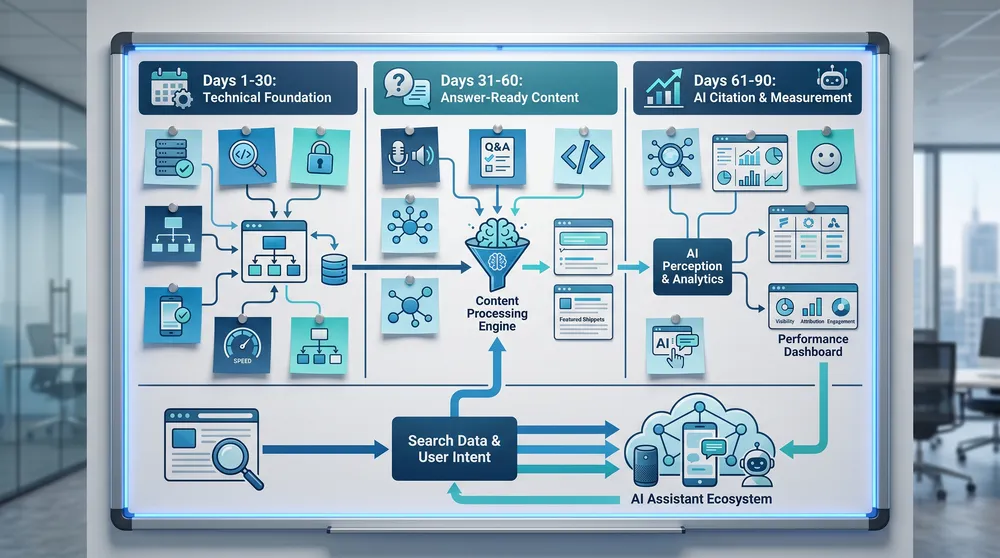
Turn the Checklist Into a Repeatable Workflow
Spend the first month fixing foundations, the second month improving answer-ready pages, and the third month measuring prompts, citations, local signals, and conversion quality.
Common Mistakes
- Buying an AI visibility tool before fixing crawlability, schema, local profile accuracy, and content quality.
- Tracking generic prompts that do not match real Australian buyer intent.
- Ignoring Google Business Profile because AI search feels more exciting.
- Using one national service page when customers search by suburb, city, or state.
- Blocking AI-search crawlers without deciding whether citations and referrals matter.
- Measuring AI visibility without tracking lead quality or revenue.
- Publishing FAQs that answer nothing useful.
- Forgetting that many AI citations come from third-party profiles, directories, reviews, and comparison content, not only your website.
Final Recommendation
Australian businesses should treat AI visibility as an extension of SEO, not a replacement. Start with the free stack, clean up technical access, strengthen local and entity proof, publish pages that answer real buyer questions, and track the prompts that matter commercially. Add paid tools when you need faster monitoring, competitor insight, and reporting depth.
The best AI search checklist is simple enough to repeat monthly: can crawlers access the right pages, can AI systems understand who we are, do our pages answer buyer questions, are we cited, do users click, and do those leads become revenue?
Sources Checked
- OpenAI - Help ChatGPT discover your products
- OpenAI crawler documentation
- Google Search Central - AI features and your website
- Google Search Console Help - AI Overviews clicks, impressions, and position
- Google Business Profile - free profile
- Google Business Profile Help - local ranking factors
- Google Business Profile Help - performance data
- Google Search Central - LocalBusiness structured data
- Bing Webmaster Blog - AI Performance public preview
- OtterlyAI product information
- Semrush AI Visibility Toolkit documentation
- Ahrefs Brand Radar documentation
- Ahrefs Custom Prompts product information
- Scrunch product information
- ZipTie.dev product information
- Cloudflare Workers Analytics Engine documentation