CMS Governance for Marketing Teams
A practical guide to CMS governance for marketing teams, comparing Hygraph, Umbraco, Optimizely, Contentful, and Contentstack across roles, workflows, approvals, scheduled publishing, localization, releases, and auditability.
CMS governance is the operating system for marketing content. It defines who can create, review, approve, translate, schedule, publish, unpublish, archive, and change the structure of the website. Good governance is not bureaucracy. It is how marketing teams move faster without accidentally publishing unfinished campaigns, outdated legal copy, broken references, or off-brand content.
The best CMS governance model depends on team size, content risk, localization needs, brand complexity, and campaign cadence. A five-person marketing team may only need simple editor roles, clear ownership, and scheduled publishing. A national or global team may need workflow stages, release calendars, legal approvals, locale-specific permissions, audit logs, and separate controls for developers and content editors.
Vendor documentation was checked on 13 May 2026 across Hygraph, Umbraco, Optimizely, Contentful, and Contentstack. Product availability can vary by plan, version, implementation, and enterprise contract, so confirm final governance features during procurement.
What CMS Governance Should Control
Marketing governance should reduce publishing risk while preserving editorial speed. These are the controls to design before content volume grows.
Roles and Permissions
Separate writers, editors, publishers, translators, legal reviewers, SEO owners, developers, admins, and agencies so people only see and change what they should.
Workflow Stages
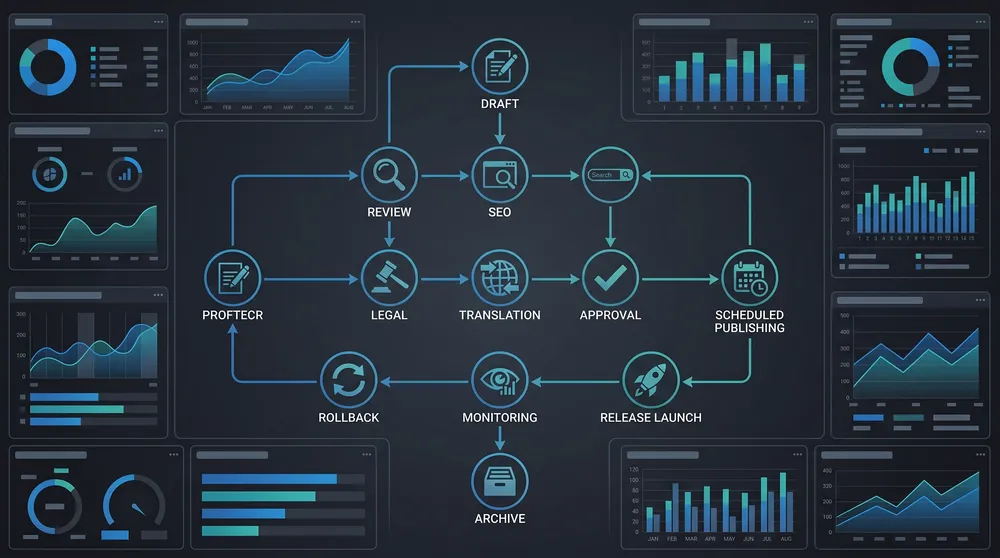
Use stages such as Draft, Review, SEO, Legal, Translation, Ready, Scheduled, Published, and Archived to make content status visible.
Publishing Rules
Require approval before production publishing, especially for regulated pages, campaign pages, pricing, legal content, and localized content.
Release Planning
Bundle related entries, assets, landing pages, navigation updates, and campaign content so launches happen together instead of one page at a time.
Localization
Govern who can edit each locale, when fallback content is acceptable, and which markets need separate approval before publication.
Audit and Recovery
Keep version history, publishing history, task ownership, workflow comments, audit logs, and rollback paths so mistakes can be traced and fixed.
The Governance Model
A practical governance model starts with the content lifecycle. Who requests content? Who writes it? Who checks accuracy? Who checks SEO? Who checks brand? Who checks legal? Who translates it? Who schedules it? Who can publish it? Who cleans it up when it expires?
The CMS should reflect those answers. If governance lives only in a spreadsheet, editors will eventually bypass it. If governance is overbuilt, teams will work around it. The useful middle ground is a CMS setup where permissions, workflows, release planning, and content structure quietly guide the right behaviour.
Governance Capability Map
| Capability | Why marketing needs it | What to check in the CMS |
|---|---|---|
| Role design | Prevents over-permissioned editors, accidental publishing, and agency access sprawl. | User groups, custom roles, field permissions, locale permissions, environment access, branch access, and admin separation. |
| Workflow stages | Makes ownership visible and keeps drafts from moving straight to production. | Stage names, transition permissions, task assignment, due dates, reviewer requirements, and self-approval prevention. |
| Approval rules | Protects legal, financial, healthcare, ecommerce, and campaign content from premature release. | Required approvers, publish restrictions, multi-step approvals, comment requirements, and audit trail. |
| Release management | Allows a campaign to launch as a coordinated set of pages, entries, assets, and references. | Releases, scheduled releases, validation before publishing, release calendar, and reference checks. |
| Localization governance | Stops one market from publishing incomplete translations or overwriting another market's content. | Locale permissions, fallback rules, translation workflow, per-locale publishing, and market-specific approval. |
| Versioning and rollback | Helps teams recover from accidental edits and prove what changed before launch. | Version history, snapshot retention, content comparison, rollback, audit log, and scheduled unpublishing. |

Governance Should Match the Team, Not the Tool Demo
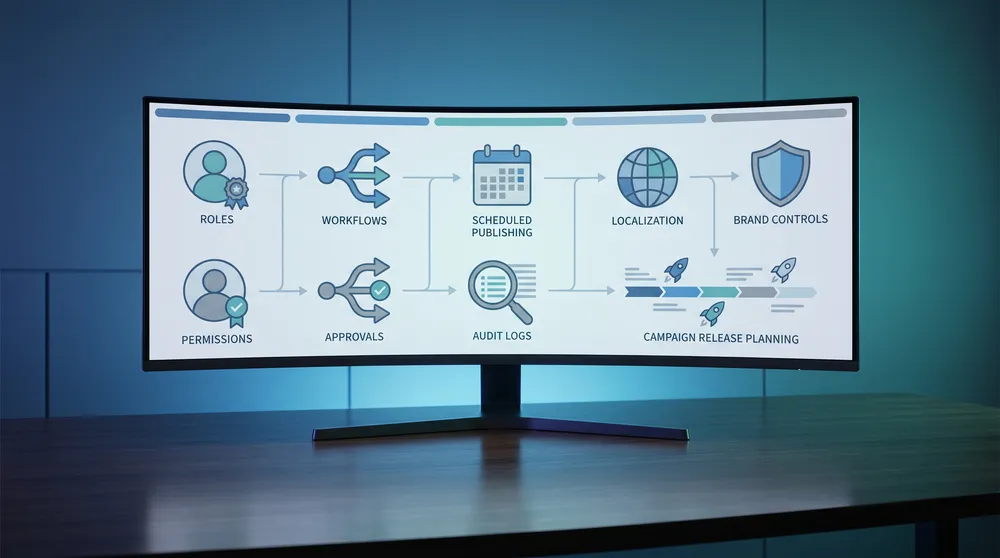
Marketing teams need the CMS to mirror real responsibilities: content creation, campaign launches, localization, approvals, brand control, and post-launch cleanup.
Governance Rules to Define First
Before choosing or reconfiguring a CMS, document these rules in plain language. Then map them to vendor features.
Who Can Publish
Decide which people can publish directly, which content types need approval, and which environments are restricted.
What Needs Review
List content that needs brand, SEO, product, legal, compliance, executive, or regional review before going live.
Locale Ownership
Assign owners for each language and market, including fallback rules, translation review, and local publishing rights.
Campaign Releases
Define how pages, entries, assets, navigation, redirects, forms, and tracking tags are grouped for a launch.
Agency Access
Give agencies scoped roles, clear expiry dates, limited environments, and no structural permissions unless required.
Cleanup Rules
Govern expiry dates, unpublishing, archiving, redirects, old campaign removal, asset cleanup, and version retention.
How the CMS Options Compare
| CMS | Governance strengths | Best fit for marketing teams | Watch-outs |
|---|---|---|---|
| Contentstack | Stack roles, custom roles, workflows, stages, workflow tasks, publish rules, branch-specific workflows, locale and environment controls, prevent self-approval, and audit logs. | Enterprise marketing teams that need strong approval gates, controlled publishing, localization governance, campaign operations, and multi-environment release discipline. | Governance is powerful but must be designed carefully. Too many workflows, stages, branches, or publish rules can slow teams if ownership is unclear. |
| Contentful | Organization and space roles, custom roles on Premium, content permissions by entries, content types, fields, tags and locales, workflows, tasks, Launch releases, scheduled publishing, release validation, and release calendars. | Composable marketing teams that need structured content, coordinated campaign releases, localization, and strong space-level governance. | Some finer content permissions rely on Premium custom roles. Governance across many spaces needs a clear operating model. |
| Optimizely CMS | Access rights for content, blocks, assets and languages, Opti ID roles, approval sequences, reviewers, comments, two-person approval patterns, drafts, version management, scheduled publishing, and multi-site support. | Enterprise teams that value mature publishing controls, page-tree governance, approvals, reusable blocks, localization, and broader digital experience platform integration. | Marketing teams should decide early whether governance lives in CMS SaaS, CMS 13, or a broader Optimizely stack because feature names and implementation details vary by product version. |
| Hygraph | Roles and permissions, system and custom content stages, environment-specific permissions, scheduled publishing and releases, version snapshots, localization controls, and GraphQL-first delivery. | Headless and GraphQL-first teams that want structured content governance, staged publishing, localization, and clean separation between editors and developers. | Custom stages and scheduled publishing can depend on plan. Marketing workflows need clear stage and permission design so the API model does not become too developer-led. |
| Umbraco | User groups, granular document permissions, language access, start nodes, document property value UI permissions, scheduled publishing, rollback, audit trail, content tree governance, and flexible .NET implementation. | Marketing teams that want an editor-friendly CMS with strong implementation control, especially for websites where the content tree mirrors ownership. | Core Umbraco governance is strong for users, permissions, scheduling, and auditability, but advanced approval workflows may require implementation choices, packages, or Umbraco Cloud/partner patterns depending on requirements. |
Vendor Notes for Governance Planning
Contentstack: strong approval and publishing controls
Contentstack is one of the strongest governance options when publishing control is the main requirement. Its docs describe workflows with stages, user and role assignments, task management, branch-specific workflows, prevent self-advancement, and publish rules that apply by branch, environment, content type, language, and action. For marketing teams, that maps well to campaign approvals, legal review, multilingual publishing, and production safeguards.
Contentful: strong release planning and structured permissions
Contentful governance is built around organizations, spaces, roles, tasks, workflows, Launch releases, scheduled publishing, and content permissions. Launch is especially useful for marketing campaigns because it lets teams group entries and assets into releases, validate them, publish immediately, or schedule publication. Content permissions can also target entries, content types, fields, tags, and locales, but fine-grained custom roles are tied to Premium plans.
Optimizely: strong enterprise publishing and approval sequences
Optimizely CMS is a strong fit where approval discipline matters. CMS SaaS and CMS 13 documentation describe access rights for content and assets, Opti ID roles, approval sequences, reviewers, comments, content approvals, two-person approval patterns, drafts, versions, and scheduled publishing. This works well for enterprise marketing teams that need review gates without losing visual editing and reusable blocks.
Hygraph: strong staged content and API governance
Hygraph governance is strongest for structured, headless operations. Roles and permissions control what users can perform and view. Content stages separate draft and published states, custom stages can support review workflows, and publishing creates version snapshots. Scheduled publishing and releases support campaign timing. Because Hygraph is GraphQL-first, governance should include API permissions, environments, locales, and content stages from the beginning.
Umbraco: strong editor control in a content-tree CMS
Umbraco gives marketing teams familiar governance primitives: users, user groups, start nodes, content and media permissions, language access, granular document permissions, property-level UI permissions, scheduled publishing, rollback, and audit trail. It is particularly practical when content ownership follows the site tree, such as sections, brands, departments, or regional websites.
Recommended Governance by Team Maturity
Small marketing team
Start with simple roles: admin, editor, publisher, and agency contributor. Use scheduled publishing, version history, clear content ownership, and a monthly cleanup rhythm. Avoid complex multi-stage workflows until there is a real review bottleneck.
Growing team with campaigns
Add task assignment, release planning, campaign calendars, SEO review, brand review, and publish permissions. Contentful Launch, Contentstack workflows and publish rules, Hygraph scheduled releases, Umbraco scheduled publishing, and Optimizely approval sequences all solve parts of this problem in different ways.
Multi-brand or multi-region team
Design governance around brand, locale, market, environment, and content type. Separate global content from local overrides. Use locale-specific permissions, workflow stages, approval rules, and release validation so one team cannot accidentally publish another team's market content.
Regulated or high-risk content team
Use enforced approvals, prevent self-approval where available, audit logs, reviewer comments, version retention, and production publishing restrictions. Pricing pages, legal pages, product claims, healthcare content, financial content, recruitment claims, and government content should not rely on trust alone.
Implementation Roadmap
| Phase | What to do | Output |
|---|---|---|
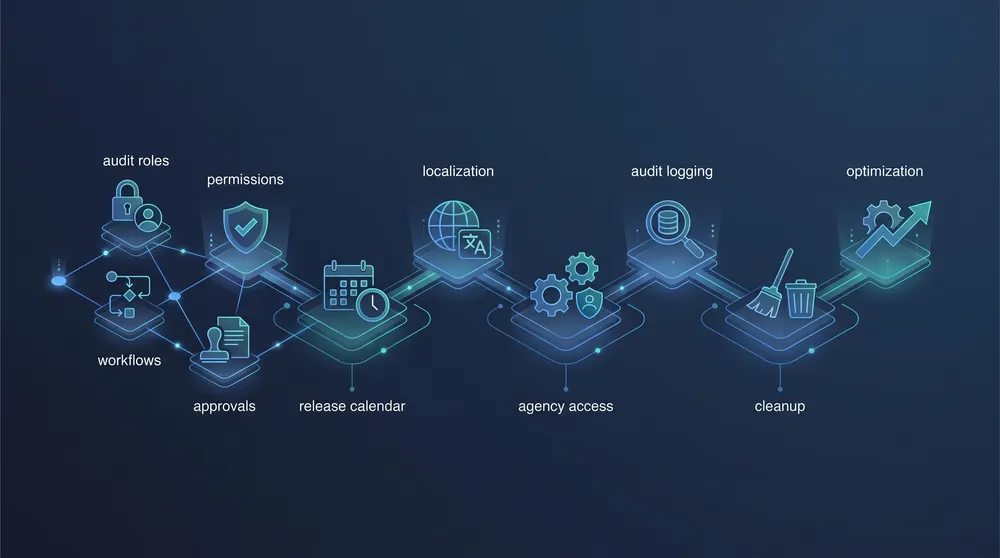
| 1. Audit | List users, agencies, content types, locales, risky pages, publishing paths, old campaigns, and current approval habits. | Governance risk map. |
| 2. Role design | Create role groups around real responsibilities, not job titles alone. Remove unnecessary admin and publish access. | Role and permission matrix. |
| 3. Workflow design | Define stage names, owners, transition rules, required approvers, deadlines, comments, and escalation paths. | Content workflow blueprint. |
| 4. Release model | Decide how campaign pages, references, media, navigation, redirects, forms, and tracking changes are launched together. | Release checklist and calendar rules. |
| 5. Cleanup | Set expiry dates, archive rules, unpublish rules, redirect handling, version retention, and ownership for old content. | Content lifecycle policy. |
Start With Publishing Risk, Then Add Control
The best governance rollout protects the riskiest publishing paths first, then expands into campaign planning, localization, agency access, and lifecycle cleanup.
Common Governance Mistakes
- Giving every marketer publish access because it is faster during launch week.
- Using one generic editor role for writers, agencies, translators, SEO reviewers, and publishers.
- Adding workflow stages that no one owns or understands.
- Forgetting that assets, references, forms, redirects, navigation, and tracking can also break a campaign launch.
- Letting agencies keep admin access after a project ends.
- Designing localization as translation only, without market approval and publishing ownership.
- Failing to archive or unpublish old campaign pages after the offer expires.
- Buying a CMS for governance features without writing down the actual governance policy.
Final Recommendation
Choose Contentstack if controlled publishing, workflow stages, branch-specific governance, and enterprise approval rules are central. Choose Contentful if structured content, release planning, tasks, scheduled publishing, and composable governance are the priority. Choose Optimizely if enterprise approval sequences, access rights, visual editing, and broader DXP governance matter. Choose Hygraph if a GraphQL-first team needs staged, structured, API-driven content governance. Choose Umbraco if the team wants flexible editor governance in a content-tree CMS with strong implementation control.
The right CMS will not fix unclear ownership. Before implementing roles or workflows, marketing should agree on the policy: who owns each content type, who can publish, what needs review, how campaigns launch, how localization works, and when old content is removed. Once that is clear, the CMS can enforce the parts that matter.
Sources Checked
- Hygraph roles and permissions
- Hygraph content stages
- Hygraph scheduled publishing
- Umbraco users, user groups, and permissions
- Umbraco scheduled publishing
- Umbraco audit trail
- Optimizely CMS SaaS access rights
- Optimizely approval sequences
- Optimizely publishing and versions
- Contentful roles
- Contentful content permissions
- Contentful workflows roles and permissions
- Contentful Launch
- Contentful scheduled publishing
- Contentstack stack roles
- Contentstack workflows
- Contentstack publish rules