Entity SEO for Local Businesses
A practical guide to entity SEO for local businesses covering Google Business Profile, Apple Business Connect, Bing Places, LocalBusiness schema, citations, reviews, local proof, AI search visibility, and tooling options.
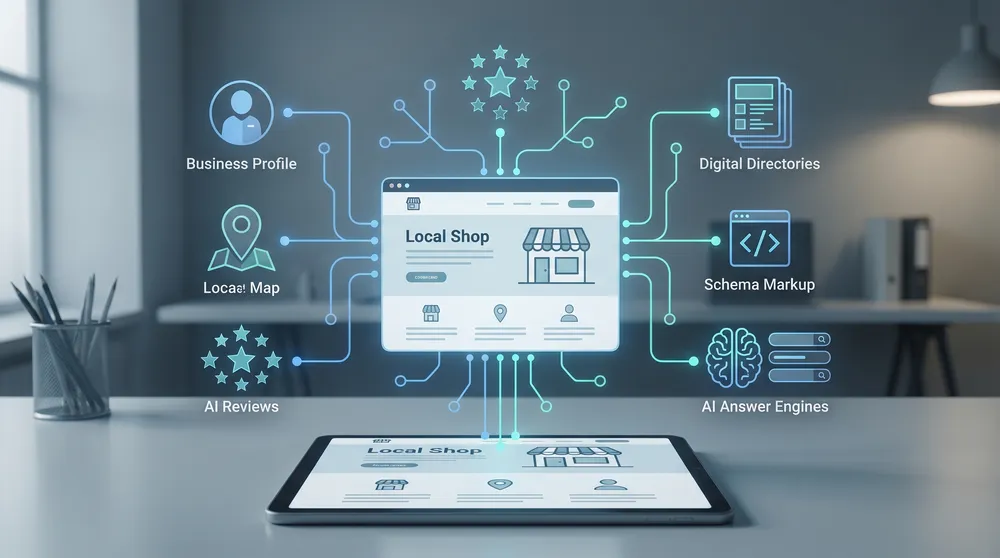
Entity SEO for local businesses is the work of making your business unmistakable across search engines, maps, directories, review platforms, structured data, and AI answer engines. It is not only about ranking for a keyword. It is about helping systems understand that your business is a real local entity with a name, category, location, service area, phone number, website, reviews, proof, and relationships to other trusted sources.
For a local business, entity SEO starts with the basics: a complete Google Business Profile, accurate Bing Places and Apple Business Connect listings, consistent name-address-phone information, LocalBusiness schema on the website, strong service and location pages, real reviews, local backlinks, and business details that match everywhere customers find you.
This matters even more in AI search. AI assistants and AI-powered search features need reliable facts. If your website says one thing, your listings say another, and your reviews describe different services, the entity becomes blurry. If every signal reinforces the same business identity, AI systems have more confidence when summarising, recommending, or citing your business.
What Search Systems Need to Understand
Entity SEO is about consistency, completeness, and corroboration across every trusted source.
Identity
Use one clear business name, trading name, website, logo, phone number, legal identifiers where relevant, and official social or directory profiles.
Location
Make addresses, service areas, suburbs, cities, opening hours, geo coordinates, parking or access details, and location pages consistent.
Category
Choose accurate primary and secondary business categories, then support them with matching services, pages, reviews, and structured data.
Reputation
Build real reviews, testimonials, ratings, case studies, media mentions, awards, accreditations, and industry memberships.
Relationships
Connect the entity to staff, founders, services, locations, products, partners, certifications, communities, events, and publications.
Behaviour
Measure calls, bookings, direction requests, website clicks, search queries, AI mentions, citations, and lead quality by location or service.
Options Snapshot
Use these options to decide whether the business needs a manual entity audit, local listing tools, citation support, review workflows, enterprise location management, or AI visibility monitoring.
| Option | Best for | What it helps with | Limitations |
|---|---|---|---|
| Google Business Profile, Google Search Console, Bing Places, and Apple Business Connect | Every local business. | Claim core business entities, manage public facts, monitor Google Search and Maps performance, update hours, services, photos, posts, and listings across major search and map ecosystems. | Free tools require manual upkeep and do not manage all citations, reviews, competitor tracking, or AI visibility in one place. |
| Manual entity audit | Small businesses starting with one location. | Check name-address-phone consistency, categories, service pages, LocalBusiness schema, social profiles, directories, reviews, local links, and duplicate listings. | Slow at scale and easy to miss old citations or inconsistent third-party profiles. |
| BrightLocal | Local SEO audits, citation tracking, citation cleanup, local rank tracking, review workflows, and agency reporting. | Local search audits, citation accuracy, Google Business Profile audits, geo-grid rankings, review management, listing sync, and local SEO reporting. | Scope usually scales by location count. Citation Builder and some listing services may be separate from core local SEO tools. |
| Semrush Local | Businesses already using Semrush or wanting Google Business Profile optimization, map rank tracking, review workflows, and local visibility tools. | Google Business Profile audit, optimization recommendations, post generation, review replies, and map rank tracking depending on plan. | Scope is usually location-based. Broader SEO and AI visibility workflows may require separate tooling. |
| Whitespark | Citation discovery, citation building, rank tracking, review generation, and local SEO service support. | Find competitor citations, discover missing local mentions, monitor citation growth, build listings, and manage reputation workflows. | Some tools and services are separate products. Choose only the modules that match the job. |
| Yext | Multi-location brands, franchises, healthcare groups, financial services, and enterprises that need structured location data at scale. | Manage business data across 200+ publishers, build entity pages, manage reviews, power site search, and maintain a central knowledge graph. | Usually overkill for a single-location small business unless listings, reviews, and knowledge graph governance are operationally complex. |
| Semrush AI Visibility Toolkit | Teams that want to measure whether the local business entity appears in AI-generated answers and AI search prompts. | AI visibility score, prompt research, prompt tracking, brand performance, competitor gaps, and AI Search Site Audit checks. | It measures AI visibility. It does not replace local listing cleanup, schema implementation, or review work. |
| Ahrefs Brand Radar and Custom Prompts | SEO teams tracking local brand mentions, competitor visibility, AI prompts, citations, and service-category share of voice. | AI Overview visibility, AI assistant mentions, citations, search demand, competitor benchmarking, and prompt monitoring. | Useful for measurement and discovery, but local entity work still needs updates across listings, website, reviews, and local proof. |
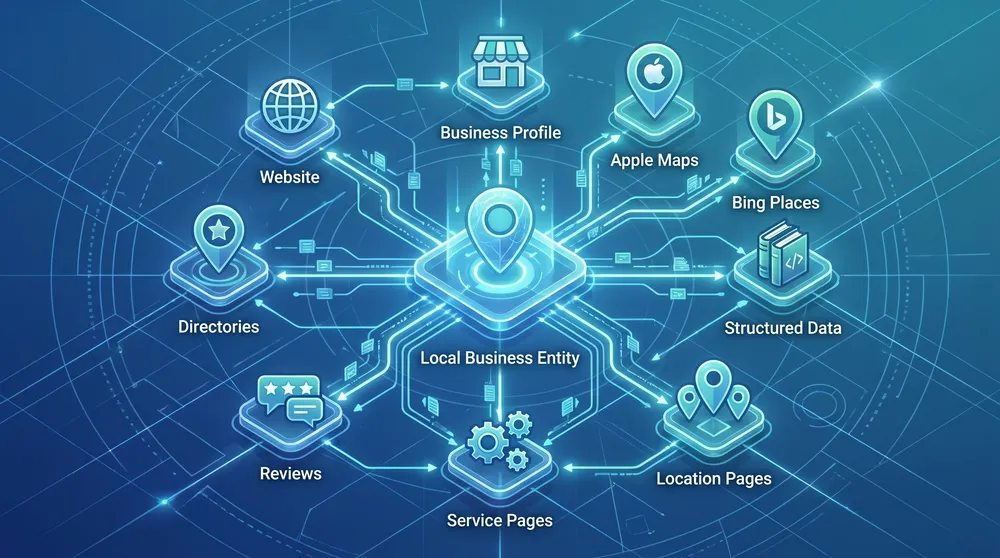
Build One Consistent Source of Truth
Your website, Google Business Profile, Apple Business Connect, Bing Places, directories, reviews, and social profiles should all describe the same business entity.
The Entity SEO Checklist
Use these checks to make a local business easier for search engines and AI systems to identify, verify, and recommend.
Claim Profiles
Claim Google Business Profile, Bing Places, Apple Business Connect, Facebook, key industry directories, and major local citation sources.
Align NAP
Keep name, address, phone, website, hours, categories, and service areas consistent across the website and third-party profiles.
Add Schema
Use Organization and LocalBusiness structured data where it matches visible page content, and validate important templates.
Strengthen Proof
Collect reviews, testimonials, case studies, photos, accreditations, awards, local partnerships, and media mentions.
Connect Services
Link the entity to service pages, location pages, staff profiles, FAQs, pricing pages, and helpful guides.
Measure Demand
Track Business Profile interactions, Search Console queries, local rankings, AI prompts, citations, calls, bookings, and lead quality.
How to Build a Local Entity
1. Define the Canonical Business Identity
Choose the official business name, trading name, primary phone number, website URL, logo, address or service area, and primary category. If the business has an ABN, ACN, licence number, professional registration, or industry membership that customers use to verify trust, include it where appropriate.
2. Complete the Major Local Profiles
Start with Google Business Profile, Bing Places, and Apple Business Connect. These are free, high-value entity sources. Add accurate hours, categories, services, photos, descriptions, opening dates, service areas, booking links, menus or products where relevant, and holiday hours.
3. Make the Website Match the Entity
Your homepage, contact page, location pages, service pages, footer, schema, and metadata should reinforce the same facts. If the website says "plumber in Newcastle" but profiles say "home maintenance contractor in Sydney", the entity becomes harder to understand.
4. Add LocalBusiness and Organization Structured Data
Google's LocalBusiness documentation says structured data can tell Google about business hours, departments, reviews where appropriate, phone numbers, addresses, geo coordinates, and more. Organization structured data can help Google understand administrative details and disambiguate the organization.
5. Build Citations and Local Mentions
Citations are mentions of your business information across directories, maps, review platforms, local media, chamber of commerce pages, supplier directories, industry associations, sponsorship pages, and community websites. Quality and consistency matter more than dumping the business into every low-quality directory.
6. Earn Reviews That Describe the Service
Reviews are not just star ratings. They are natural-language evidence about what the business does, where it works, who it helps, and whether customers trust it. Ask customers to be specific and respond professionally. Do not script fake review text.
7. Connect the Entity to People, Services, and Places
Entity SEO gets stronger when the business is connected to real-world relationships: founders, team members, practitioners, service categories, products, suburbs, partners, awards, events, case studies, and customer stories.

Website Structure for Entity SEO
Your website should act as the canonical hub for the business entity. Use a clear homepage, contact page, about page, service pages, location pages, review or case-study pages, and FAQ content. Link them together with descriptive anchor text so customers and crawlers can understand the relationships.
For a one-location business, the homepage and contact page often carry most of the entity details. For a multi-location business, each location should usually have a dedicated page with unique address, phone, hours, team, service area, photos, reviews, directions, parking, and local proof.
Structured Data Priorities
- Organization: use on the homepage for business identity, logo, URL, contact points, sameAs profiles, and relevant identifiers.
- LocalBusiness: use on location pages or contact pages where business location details are visible.
- Service: use schema.org Service markup where it helps describe service offerings, provider, and area served.
- BreadcrumbList: use across the site to clarify page hierarchy.
- Review or AggregateRating: only use where the site captures and displays valid review content that follows Google guidelines.
Do not use schema to invent facts. Structured data should reinforce what the page visibly says.

Track Entity Strength Over Time
Entity SEO should be measured by accuracy, visibility, reputation, engagement, and leads, not just map pack rankings.
Recommended Setup by Maturity
Foundation
Claim and complete Google Business Profile, Bing Places, Apple Business Connect, Google Search Console, and your main social profiles. Add LocalBusiness and Organization schema manually, clean the website facts, and track reviews and leads in a spreadsheet.
Single-location Growth
Add local SEO tooling when you need citation tracking, map tracking, review workflows, listing checks, or AI prompt monitoring for one location or service area.
Multi-location Operations
Add broader citation, review, AI visibility, and reporting workflows when local entity visibility is a monthly KPI across multiple locations, practitioners, suburbs, or service areas.
Enterprise Governance
Use enterprise listing management, reputation workflows, AI visibility monitoring, and agency-managed local SEO when you manage many locations, franchises, practitioners, or regulated service areas.
Common Mistakes
- Using different business names, phone numbers, or addresses across important profiles.
- Choosing categories that are aspirational instead of accurate.
- Ignoring Apple Business Connect and Bing Places because Google gets most of the attention.
- Adding LocalBusiness schema without matching visible business details on the page.
- Creating location pages with duplicated text and no local proof.
- Chasing hundreds of weak citations instead of fixing major sources and earning real local mentions.
- Only measuring rankings while ignoring calls, direction requests, bookings, leads, and review quality.
- Letting outdated hours, old phone numbers, closed locations, or duplicate listings remain live.
Final Recommendation
Start with the free entity foundations: Google Business Profile, Bing Places, Apple Business Connect, Search Console, a clean website, and accurate structured data. Then fix citations, build local proof, earn detailed reviews, and connect your business to services, people, places, and trusted external sources.
The local business that wins in search and AI discovery is usually the one that is easiest to verify. Make every important source tell the same story about who you are, what you do, where you operate, and why customers trust you.
Sources Checked
- Google Business Profile Help - improve local ranking
- Google Business Profile Help - performance data
- Google Search Central - LocalBusiness structured data
- Google Search Central - Organization structured data
- Google Search Console Help - about Search Console
- Apple Business Connect
- Bing Blog - new Bing Places for Business
- BrightLocal product information
- BrightLocal Simply Listings and Citation Builder documentation
- Semrush Local product information
- Whitespark product information
- Whitespark Local Citation Finder product information
- Yext Listings platform
- Semrush AI Visibility Toolkit documentation
- Ahrefs Brand Radar documentation
- Ahrefs Custom Prompts product information