Headless CMS Personalization Explained
A practical guide to headless CMS personalization, covering how it works, the main implementation options, vendor choices, pricing in AUD, data requirements, governance, testing, and rollout planning.
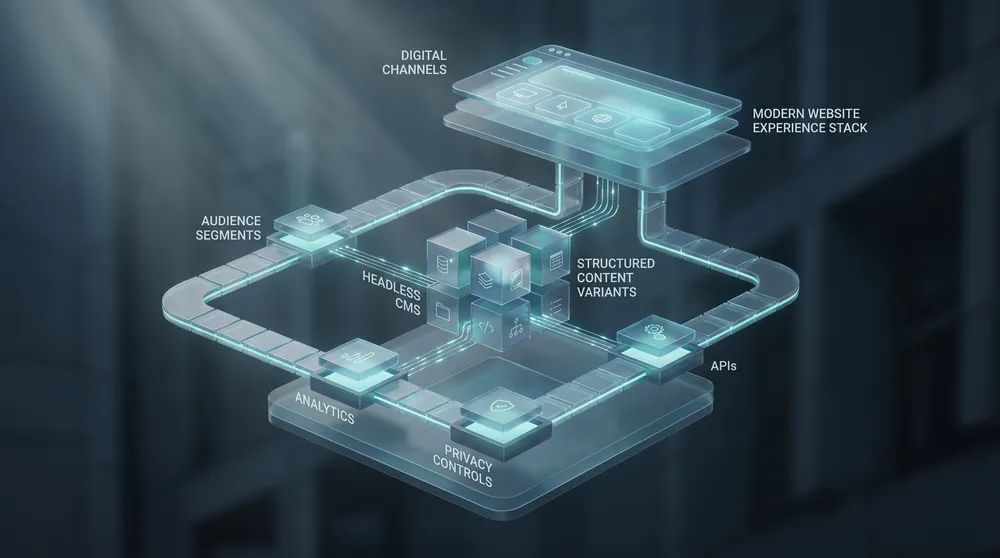
Headless CMS personalization means serving different content, components, offers, messages, or journeys to different visitors while the CMS remains separate from the front end. The CMS stores structured content. The personalization layer decides which version should appear. The website, app, kiosk, portal, or commerce front end renders the result.
That separation is powerful, but it also creates choices. You can personalize inside a CMS platform such as Contentful or Contentstack, use a composable DXP layer such as Uniform, connect a headless CMS to an experimentation platform such as Optimizely or Vercel Flags, or build a lightweight rules layer in your own front end.
Pricing was checked on 11 May 2026. US-dollar prices are converted to AUD using your requested planning rate of 1.7x. Treat all costs as planning estimates because vendor prices, limits, taxes, exchange rates, contracts, and usage can change.
What Personalization Actually Needs
A good personalization program has more than a CMS toggle. It needs content variants, audience rules, data quality, testing, analytics, consent, and a rollout model that editors can manage.
Content Variants
Create reusable content blocks for audience, region, campaign, lifecycle stage, industry, account type, product interest, or intent.
Audience Data
Use first-party behaviour, CRM data, CDP segments, account attributes, geolocation, campaign parameters, logged-in status, or product usage signals.
Decision Logic
Choose rule-based targeting, feature flags, experimentation, AI suggestions, recommendations, or journey orchestration depending on maturity.
Delivery Layer
Decide whether personalization runs at build time, server-side, edge-side, or client-side. The wrong choice can hurt speed or measurement.
Measurement
Track conversions, assisted revenue, lead quality, engagement, experiment lift, audience overlap, content fatigue, and false positives.
Governance
Document consent, privacy, fallback content, approval workflows, data ownership, testing rules, and who can launch personalized experiences.
Options and Cost Snapshot
Pricing checked on 11 May 2026. USD prices use the requested 1.7x AUD planning conversion. Implementation, strategy, content production, analytics setup, consent management, integrations, GST, data warehousing, experimentation design, and agency costs are separate unless noted.
| Option | Cost snapshot | Best for | What you get | Watch-outs |
|---|---|---|---|---|
| Contentful Personalization | Contentful Platform Free is USD 0. Lite is USD 300/month, about AUD 510/month. Premium is custom. Contentful Personalization is available on Premium Platform plans and the Start, Core, and Scale personalization tiers are contact-sales. | Teams already using or shortlisting Contentful who want personalization, A/B testing, segmentation, AI suggestions, insights, and data connections inside the Contentful workflow. | Start includes 100K monthly active profiles, 100 AI Suggestions, unlimited A/B tests and personalized experiences, segmentation, performance analysis, basic data connections, EU data residency, and one Space enabled. Core increases to 500K profiles and 500 AI Suggestions. Scale increases to 1M profiles and 1000 AI Suggestions, with shared audiences and centralized experiences across spaces. | The published dollar price is for the base Platform plans, not the personalization add-on. Budget requires a Premium quote, personalization tier scoping, profile volume, AI usage, data connections, support, and implementation. |
| Contentstack Omnichannel Personalization | Official pricing is sales-led. Contentstack lists Headless CMS, Real-time CDP, and Agentic Experience Platform options but does not publish public dollar prices on its plans page. | Enterprise teams that want CMS, data activation, real-time journey orchestration, testing, AI content, and personalization in a broader digital experience platform. | Personalization at the point of request, GraphQL, APIs, SDKs, UI extensions, real-time journey orchestration, anonymous and known-user flows, audience insights, journey analytics, predictive cohorts, AI-powered content, and A/B/n testing. | Best evaluated through procurement. Ask for total annual subscription, implementation assumptions, CDP/data costs, front-end hosting, connectors, support tier, onboarding, and usage limits. |
| Uniform DXP or Personalization and A/B Testing | Uniform DXP Lite starts at USD 12,000/year, about AUD 20,400/year. Professional, Enterprise, and the standalone Personalization and A/B Testing package are contact-sales. | Composable stacks where the CMS is only one source and marketers need visual composition, edge personalization, A/B testing, and integration across CMS, commerce, analytics, and customer data. | DXP Lite includes limited personalization and A/B testing. Professional and Enterprise list unlimited personalization and A/B testing under fair use. The standalone personalization package includes one production project, two non-production projects, one pre-built data integration, unlimited personalization, unlimited A/B tests, unlimited users, custom integrations, insights, and tailored onboarding. | Uniform can be valuable when the stack is multi-source, but it adds another platform layer. Confirm whether you need DXP, only personalization/testing, or a simpler CMS-native approach. |
| Storyblok plus personalization integrations | Starter is free. Growth is USD 99/month, about AUD 168.30/month. Growth Plus is USD 349/month, about AUD 593.30/month. Premium and Elite are custom. | Teams that want visual editing, component content, regional variants, localization, test variations, and integrations with tools such as VWO, Dynamic Yield, or Optimizely. | Storyblok promotes real-time personalized content delivery through API-first delivery, region, language, or test variation resolution, reusable personalized blocks, visual preview, and integrations with VWO, Dynamic Yield, and Optimizely. | Storyblok is strong for structured content variants and visual editing, but advanced behavioural personalization usually depends on the connected experimentation or personalization tool. |
| Vercel Flags with a headless CMS | Vercel Flags is available in beta on all plans. Hobby includes up to 10,000 flag requests/month. Pro and Enterprise have no stated monthly maximum. Additional flag requests are USD 30 per 1M, about AUD 51 per 1M. | Frontend teams using Vercel who want flags, targeting, gradual rollouts, and A/B tests tied to a headless CMS content model. | Create flags, define targeting rules, use reusable segments, roll out gradually, run A/B tests, and measure through Vercel Web Analytics or your own analytics/data warehouse. | It is not a CMS or full personalization suite. You still need content variants, identity/segment data, analytics, consent handling, and developer implementation. |
| Optimizely Personalization or Web Experimentation | Request pricing. Optimizely does not publish public dollar prices for Personalization, Web Experimentation, Data Platform, CMS, or Feature Experimentation on its plans page. | Teams that need a mature experimentation and personalization platform alongside a headless CMS, especially when conversion testing, predictive audiences, and measurement discipline matter. | Optimizely Personalization covers real-time audiences, behaviour-based personalization, no-code experience creation, ROI measurement, and integration with first-party and third-party data. Web Experimentation includes A/B tests, Stats Engine, content personalization, and AI predictive audiences. | Budget for platform quote, setup, experiment design, analytics integration, privacy review, development support, and ongoing optimization operations. |
| Lightweight custom rules layer | No separate personalization software fee, but implementation and maintenance are internal or agency costs. | Small and medium businesses that only need simple rules such as location, referrer, campaign, logged-in state, industry page, or known customer status. | Use the CMS to store variants and the front end to choose which variant appears. This can be enough for landing pages, local service pages, basic account messaging, or campaign pages. | Harder to scale without governance, testing, reporting, consent management, and editor-friendly controls. Avoid building a mini DXP unless the business case is clear. |
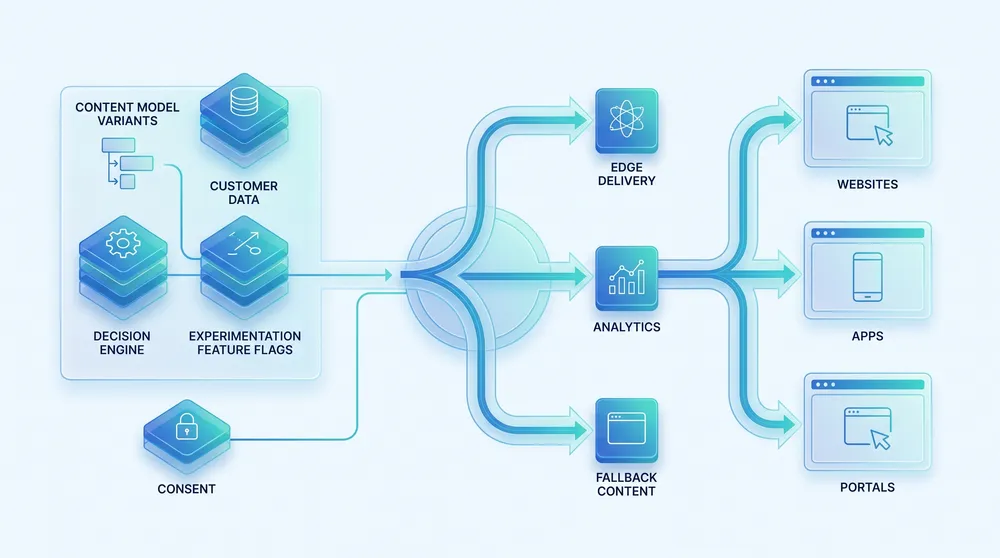
Headless CMS Personalization Is a Stack
The CMS stores structured content variants. The decision layer chooses an experience. The front end renders it. Analytics proves whether it worked.
What to Decide Before Buying
Most personalization failures happen before the tool is installed. The hard work is choosing the audiences, content model, measurement rules, and operating model.
Audience Source
Decide whether audiences come from behaviour, CRM, CDP, analytics, account data, geolocation, campaign parameters, or logged-in state.
Content Model
Model personalized blocks, fallback content, variant names, reusable components, legal copy, and localization before launching.
Delivery Mode
Choose client-side, server-side, edge-side, or static build-time delivery based on speed, caching, SEO, and measurement needs.
Experiment Rules
Define when to test, sample sizes, control groups, success metrics, audience exclusions, and how winners are promoted.
Privacy
Document consent, data minimisation, sensitive attributes, retention, regional requirements, and what happens before consent is given.
Editor Workflow
Give editors clear naming, previews, approvals, expiry dates, fallback content, and a way to see which variant is live.
The Main Personalization Patterns
| Pattern | Example | When it works | Risk |
|---|---|---|---|
| Rule-based content | Show a different hero to visitors from Sydney, Melbourne, or Brisbane. | Simple regional, campaign, industry, or lifecycle messaging. | Rules multiply quickly and become hard to audit. |
| Segment-based content | Show enterprise proof points to enterprise accounts and price-led copy to small business visitors. | Useful when CRM, CDP, account, or analytics segments are reliable. | Weak data creates weak personalization. |
| Experiment-led personalization | Test three value propositions and route more traffic to the best performer. | Best when conversion impact matters and traffic volume is high enough. | Small samples can produce misleading winners. |
| Journey orchestration | Move a known user from education content to product comparison to sales conversion based on behaviour. | Best for mature teams with first-party data and multi-channel journeys. | Requires strong data integration, governance, and measurement. |
| AI-assisted personalization | Suggest audiences, create variants, or recommend next-best content based on performance data. | Useful once content, analytics, and approval workflows are already reliable. | AI can scale poor strategy if goals, guardrails, and review are weak. |
What Changes in a Headless Architecture
In a traditional CMS, personalization is often tied to the page renderer. In a headless CMS, the content and rendering are separated, so you need to decide where the decision happens. The decision can happen in the browser, on the server, at the edge, inside a personalization vendor, or through a feature flag service.
That decision affects cacheability, page speed, privacy, SEO, content previews, analytics attribution, and editorial control. For most business websites, start with low-risk rules and experiment-led improvements before attempting complex one-to-one personalization.

Which Option Should You Choose?
Choose CMS-native personalization when editors need control
Contentful Personalization and Contentstack Omnichannel Personalization make sense when marketers need to create, preview, test, and measure personalized content close to the CMS workflow. This is attractive when the CMS is already central to the business and personalization should be managed by content and marketing teams, not only developers.
Choose Uniform when the stack is composable and multi-source
Uniform is better suited to teams that assemble experiences from multiple systems, such as a CMS, commerce platform, DAM, analytics, and customer data sources. It can sit above the CMS and provide visual composition, personalization, and A/B testing across the stack.
Choose Storyblok plus integrations for visual content variants
Storyblok is a strong option when personalization is mostly regional, language-based, campaign-based, or component-based, and when the team values visual editing. For advanced behavioural targeting, its own page points to integrations with VWO, Dynamic Yield, and Optimizely.
Choose Vercel Flags for developer-led targeting and experiments
Vercel Flags can work well when a Vercel-hosted front end needs flags, targeting, gradual rollouts, or A/B tests using content pulled from a headless CMS. It is a lean option, but it still needs analytics, content governance, and developer ownership.
Choose Optimizely when experimentation is the core discipline
Optimizely is a better fit when the business wants a mature experimentation and personalization program across channels, not just a few CMS content variants. It is usually a larger investment and should be evaluated with conversion volume, governance, and reporting needs in mind.
Common Mistakes
- Buying a personalization platform before defining audiences and content variants.
- Using third-party data when first-party behaviour and CRM signals would be more reliable.
- Creating too many variants for editors to maintain.
- Personalizing before the default experience is clear, fast, and useful.
- Running tests without enough traffic or a real control group.
- Ignoring consent, privacy, and sensitive attribute risks.
- Letting personalization logic live only in developer code with no editorial visibility.
- Measuring clicks when the real goal is leads, revenue, retention, or qualified enquiries.
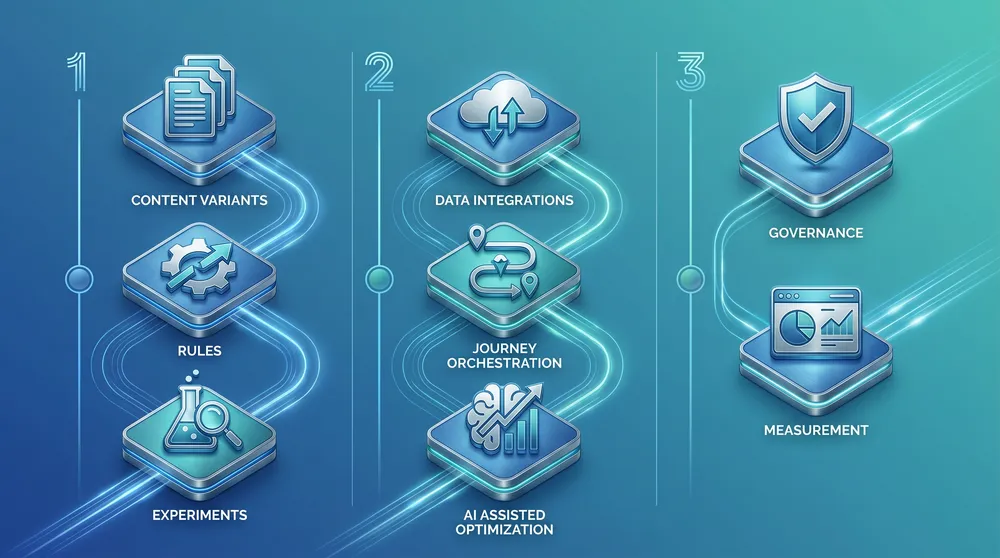
Start Narrow, Then Scale What Works
The safest personalization roadmap starts with simple rules, clear fallbacks, and measurable experiments before moving into richer journey orchestration.
A Practical Rollout Roadmap
Phase 1: Foundation
Audit the current website, analytics, conversion events, consent banner, CRM data, and content model. Pick two or three high-value audiences and define the default experience for everyone else.
Phase 2: Content Variants
Create reusable personalized blocks in the CMS, not duplicated pages. Start with hero copy, proof points, call-to-action blocks, industry examples, local service messaging, and product recommendations.
Phase 3: Rules and Experiments
Launch a small number of rules with strong fallback content. Where traffic allows, turn assumptions into A/B tests with control groups and a single primary success metric.
Phase 4: Data and Journey Growth
Once the basics work, connect CRM, CDP, commerce, or product usage data. Move from isolated page variants to lifecycle journeys, account-based experiences, and next-best-content recommendations.
Phase 5: Governance
Create naming conventions, approval rules, expiry dates, content ownership, test documentation, privacy review, reporting cadence, and a cleanup process for old variants.
Final Recommendation
For most Australian businesses, the best first step is not an enterprise personalization suite. Start by improving content structure in the CMS, defining audiences clearly, adding analytics events, and testing a few high-impact variants. Then choose the tool based on what is actually blocking progress.
Use CMS-native personalization when content teams need autonomy inside the CMS. Use Uniform when your experience is assembled from several systems. Use Storyblok plus integrations when visual component editing and regional variants matter. Use Vercel Flags when the front-end team owns targeting logic. Use Optimizely when experimentation is a serious growth function.
Sources Checked
- Contentful pricing and Personalization plan details
- Contentful Personalization product page
- Contentstack plans page
- Contentstack Omnichannel Personalization
- Uniform pricing
- Storyblok pricing
- Storyblok personalization
- Vercel Flags documentation
- Vercel Flags limits and pricing
- Optimizely plans and pricing