
How to Get Cited in Google AI Overviews
A practical guide to improving your chances of being cited in Google AI Overviews with helpful content, crawl access, structured data, page experience, Search Console measurement, and AI visibility tools.
The honest answer is that you cannot force a citation in Google AI Overviews. Google decides when an AI Overview is useful, which links support the answer, and which pages are shown. But you can improve your odds by making your content eligible for Google Search, clear enough to support a generated answer, and trustworthy enough to be selected as a useful source.
Google's own guidance is blunt: there are no additional technical requirements, no special AI Overview schema, and no new AI text file required to appear in AI Overviews or AI Mode. To be shown as a supporting link, a page must be indexed, eligible to appear in Google Search, and eligible to show a snippet. That means the foundation is still classic SEO: crawlability, indexability, helpful content, visible text, internal links, structured data that matches the page, page experience, and accurate Business Profile or Merchant Center data where relevant.
The difference is the query shape. AI Overviews often appear for broader, multi-step, explanatory, comparative, and decision-support searches. Google says AI Mode and AI Overviews may use query fan-out, meaning Google can search across related subtopics and data sources before forming the response. If your page answers only one thin keyword variation, it may not be enough. If your page explains the topic clearly, covers related buyer questions, cites evidence, and connects to supporting pages, it has a better chance of being useful.
What Makes a Page Citation-Worthy
Think less about tricking AI Overviews and more about becoming the page Google can safely use to support an answer.
Indexed and Snippet-Eligible
The page must be crawlable, indexable, and eligible to show a snippet. Avoid accidental noindex, nosnippet, blocked resources, and robots.txt mistakes on priority pages.
Direct Answer Blocks
Use concise answer sections, comparison tables, definitions, steps, FAQs, examples, pricing context, and eligibility notes that can support complex search queries.
Topical Depth
Cover the main question and the related subtopics a user would naturally ask next. AI Overviews can draw from multiple related searches, not only the exact query.
Trust and Proof
Show author or reviewer details, evidence, original experience, sources, dates, case studies, credentials, reviews, and clear business information.
Structured Facts
Use schema that honestly matches visible content, such as Article, Product, LocalBusiness, Organization, FAQPage, BreadcrumbList, and Service where appropriate.
Strong Page Experience
Make important content easy to load, read, navigate, and verify. Support text with helpful images or videos when they genuinely improve understanding.
Options Snapshot
Use these options to decide whether you need free Google diagnostics, technical SEO crawling, AI Overview monitoring, prompt tracking, citation research, or broader visibility reporting.
| Option | Best for | What it helps with | Limitations |
|---|---|---|---|
| Google Search Console, GA4, Rich Results Test, PageSpeed Insights, Business Profile, and Merchant Center | Every website trying to improve Google AI Overview eligibility and measurement. | Indexing checks, search performance, AI Overview clicks and impressions inside Web search reporting, structured data testing, page experience checks, local entity data, and ecommerce product data. | Google does not provide a simple AI Overview-only filter in Search Console. You still need analysis and interpretation. |
| Manual content and citation audit | Small businesses and teams that need to improve core pages before buying tools. | Identify pages that need better answers, clearer evidence, stronger internal links, updated facts, better author details, schema, and snippet eligibility fixes. | Manual work is slower and harder to benchmark against competitors. |
| Screaming Frog SEO Spider | Technical SEO audits before pushing for AI Overview citations. | Crawlability, noindex and nosnippet checks, broken links, duplicate pages, structured data validation, page titles, headings, internal links, JavaScript rendering, and Search Console integration. | It audits your website. It does not tell you which AI Overview prompts cite you unless combined with search and AI visibility data. |
| OtterlyAI | Teams that want daily tracking for Google AI Overviews alongside ChatGPT, Perplexity, and Microsoft Copilot. | Prompt tracking, brand visibility, citation analysis, GEO audits, recommendations, and exports. | Prompt limits and add-ons matter. It tracks visibility; it does not automatically fix content quality or technical SEO. |
| Semrush AI Visibility Toolkit | Marketing teams that want AI visibility tracking, prompt monitoring, brand sentiment, and technical AI-search checks. | AI visibility score, citations, brand mentions, prompt tracking, competitor gaps, and AI Search Checks in Site Audit. | It is a monitoring and audit layer. Content, schema, crawl, and authority fixes still need implementation. |
| Ahrefs Brand Radar and Custom Prompts | SEO teams that want AI Overview visibility research, citation discovery, competitor comparisons, and specific buyer-prompt monitoring. | AI Overview visibility, brand mentions, citations, prompt checks, share of voice, competitor benchmarking, and content gap research. | Included prompt checks and regional coverage vary. Pair with Search Console and GA4 to understand traffic and conversions. |
| Scrunch | Brands and agencies that want Google AI Overview monitoring alongside other AI answer engines. | AI visibility benchmarks, prompt monitoring, site audits, citation visibility, reporting, and recommendations. | Core supports a defined prompt and workspace limit. Enterprise is needed for broader model coverage and integrations. |
| ZipTie.dev | Teams that want a lower-cost AI search monitoring option focused on Google AI Overviews, ChatGPT, and Perplexity. | AI search checks, AI data summaries, content optimization suggestions, and prompt generation support. | Coverage and limits are narrower than larger enterprise AI visibility platforms. |

First, Make the Page Eligible to Be Cited
If Google cannot crawl, index, render, and show a snippet for the page, the page is unlikely to appear as a supporting link in AI Overviews.
How to Improve Your Citation Chances
Use this checklist on commercial pages, guides, category pages, product pages, and local landing pages that should support AI Overview answers.
Allow Crawling
Check robots.txt, CDN rules, noindex, canonical tags, and blocked resources. Keep important text visible in rendered HTML.
Answer Directly
Add short answer sections before deeper explanation. Make definitions, steps, pros and cons, and decision criteria easy to extract.
Add Evidence
Use original examples, statistics, screenshots, case studies, expert review, product details, and dated updates where useful.
Build Topic Clusters
Connect the main guide to supporting pages that cover subtopics, comparisons, pricing, locations, FAQs, and implementation details.
Match Schema to Content
Add structured data only where it matches visible page content. Validate important templates before publishing at scale.
Measure Results
Track Search Console changes, AI Overview prompt checks, citations, referral sessions, engagement, leads, and conversion quality.
The Practical Process
1. Pick Queries Where AI Overviews Actually Appear
Do not optimize every page blindly. Build a short list of commercial and informational queries where AI Overviews show up for your market. Look for complex searches, comparisons, how-to questions, cost questions, eligibility questions, and multi-step buying decisions.
For each query, record which sources are cited, what angle the AI Overview takes, which subtopics appear, and what follow-up questions Google suggests. This gives you a content brief based on the actual search surface, not guesswork.
2. Make Your Page a Better Supporting Source
Improve the page so it can support the answer. Add a concise summary, clear definitions, practical steps, comparison criteria, examples, limitations, costs, risks, and proof. If the topic is local or commercial, include business details, service areas, pricing factors, availability, reviews, and contact paths.
3. Strengthen E-E-A-T and Trust
Google's helpful content guidance asks whether content is original, comprehensive, trustworthy, expert, and created for people. Add author or reviewer information, explain how the content was produced, cite sources, update stale sections, and show firsthand experience. For finance, health, legal, safety, and other YMYL topics, trust signals matter even more.
4. Cover the Query Fan-Out
AI Overviews can draw from related searches and subtopics. Create internal links to supporting pages that answer follow-up questions. A single page does not need to answer everything, but your site should make the topic easy to explore.
5. Use Structured Data as a Clarity Layer
Structured data is not a shortcut to AI Overview citations, but it helps Google understand content when it is accurate and visible on the page. Use Article, Product, LocalBusiness, Organization, BreadcrumbList, FAQPage, Review, Service, and Merchant Center product data where relevant.
6. Measure the Right Way
Google reports AI Overview links inside Search Console Web performance data. A click from a link in an AI Overview counts as a click, and links in the same AI Overview share the AI Overview's position. Combine Search Console with GA4, CRM data, and prompt visibility tools to understand whether citations are producing qualified traffic and leads.

Content Patterns That Earn More Citations
- Clear definitions: Start important sections with a plain-language answer before adding nuance.
- Comparison tables: Explain differences, trade-offs, use cases, and who each option suits.
- Step-by-step processes: Break complex tasks into ordered actions with practical context.
- Pricing explainers: Show cost ranges, pricing factors, inclusions, exclusions, and examples.
- Original examples: Add screenshots, real scenarios, case studies, data, or experience that competitors lack.
- FAQ sections: Answer the follow-up questions buyers ask after the main query.
- Proof sections: Include reviews, credentials, policies, guarantees, sources, and update notes.
- Internal links: Connect the page to deeper guides, product pages, service pages, locations, and support content.
Technical Checks Before Publishing
- The page is indexable and returns a 200 status code.
- The canonical URL points to the page itself or the correct canonical version.
- Googlebot can crawl important CSS, JavaScript, images, and content.
- The page is eligible for snippets and not blocked by
nosnippetor overly restrictivemax-snippet. - The page appears in XML sitemaps if it is strategically important.
- Structured data validates and matches visible content.
- Images have descriptive alt text and appear on helpful landing pages.
- The page has useful internal links from related pages.
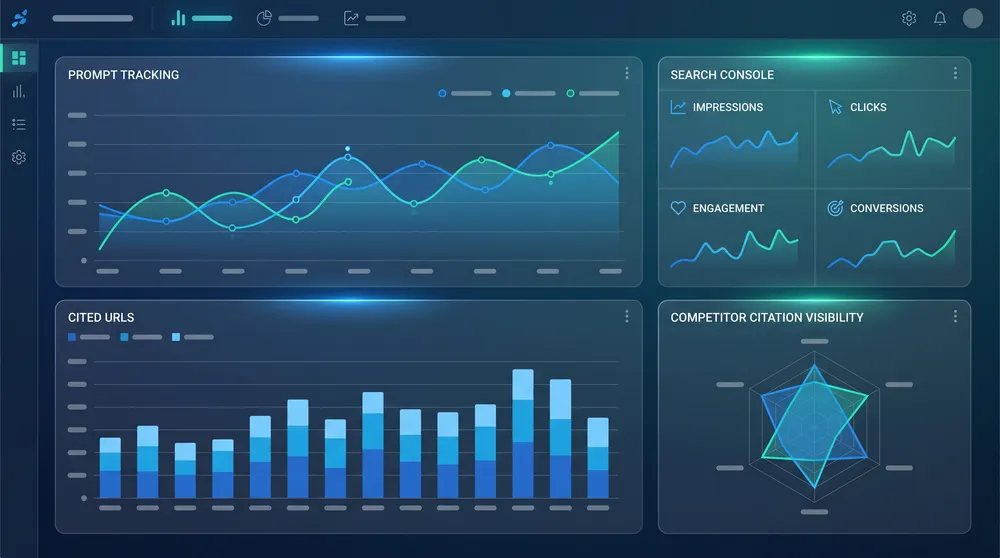
Track Citations, Not Just Rankings
AI Overview visibility is part search performance, part citation visibility, and part conversion quality. One ranking report will not tell the full story.
Recommended Setup by Maturity
Foundation
Use Google Search Console, GA4, Rich Results Test, PageSpeed Insights, Merchant Center or Business Profile where relevant, and manual AI Overview checks. This is enough to find indexing issues, measure Google Web performance, and improve core pages.
Early Monitoring
Add lightweight AI Overview and prompt tracking when manual checks are too slow or when the team needs repeatable reporting across priority buyer prompts.
Active Growth
Add broader visibility monitoring and expanded custom prompt sets when AI Overview citations become a monthly KPI and competitors need to be tracked consistently.
Advanced Operations
Use larger visibility, SEO, and reporting setups when you manage multiple brands, countries, locations, product categories, or content teams. Plan for implementation time as well as software selection.
Common Mistakes
- Looking for a special AI Overview schema instead of fixing content, crawl, snippets, and trust.
- Blocking snippets or Googlebot and then expecting citation visibility.
- Publishing generic AI-written summaries that add no original value.
- Ignoring the pages already cited by AI Overviews for target queries.
- Using structured data that does not match visible content.
- Tracking rankings but not citations, Search Console clicks, engagement, or conversions.
- Forgetting Business Profile or Merchant Center data for local and ecommerce queries.
- Assuming one citation proves business impact without lead-quality measurement.
Final Recommendation
To get cited in Google AI Overviews, start by making the page eligible for Google Search and snippets. Then make it the best supporting source for a complex answer: direct, complete, trustworthy, current, well structured, and connected to deeper resources. Tools can help you monitor opportunities, but the citation is earned by the page and the site behind it.
The strongest AI Overview strategy is not "write for AI". It is: answer real searcher questions better than the current cited sources, make the answer easy for Google to understand, and measure whether visibility turns into qualified visits and leads.
Sources Checked
- Google Search Central - AI features and your website
- Google Search Console Help - AI Overviews clicks, impressions, and position
- Google Search Central - helpful, reliable, people-first content
- Google Search Central - Search appearance and structured data
- Google Search Central - image SEO best practices
- Google Rich Results Test
- Google Business Profile
- Google Merchant Center - free listings
- Screaming Frog SEO Spider features
- OtterlyAI product information
- Semrush AI Visibility Toolkit documentation
- Ahrefs Brand Radar documentation
- Ahrefs Custom Prompts product information
- Scrunch product information
- ZipTie.dev product information