
How to Structure Service Pages for AI Search
A practical guide to structuring service pages for AI search, Google AI Overviews, ChatGPT, Copilot, and Perplexity with clear answers, proof, schema, internal links, pricing context, and measurement.
A service page built for AI search is not just a sales page with keywords. It is a clear source of truth that helps search engines and AI answer engines understand the service, the provider, the customer problem, the process, the proof, the locations served, the pricing factors, and the next step.
Google says the same SEO foundations apply to AI features like AI Overviews and AI Mode: pages need to be crawlable, indexable, helpful, easy to find through internal links, textually clear, and backed by structured data that matches visible content. AI assistants such as ChatGPT, Copilot, Perplexity, and Gemini also tend to reward clarity. If a service page is vague, thin, or full of generic claims, it gives AI systems very little to cite or recommend.
The best structure is simple: define the service, explain who it is for, show the outcomes, describe the process, answer buyer questions, prove credibility, explain pricing factors, connect related services, and make conversion easy. The goal is not to write a longer page. The goal is to remove ambiguity.
What Every AI-Ready Service Page Needs
These sections give search systems and buyers enough context to understand, compare, and trust the service.
Clear Service Definition
State the service in plain language, who it helps, what problem it solves, and what outcome the customer can expect.
Buyer Questions
Answer cost, timeline, eligibility, inclusions, exclusions, risks, alternatives, locations, and common objections directly on the page.
Proof and Experience
Show case studies, before-and-after examples, testimonials, reviews, awards, credentials, licences, process evidence, and real project details.
Structured Facts
Use Organization, LocalBusiness, Breadcrumb, Article, Product or Service-style schema where relevant, and keep all markup aligned with visible content.
Internal Links
Link to related services, industry pages, location pages, guides, pricing explainers, FAQs, case studies, and contact pathways using descriptive anchor text.
Conversion Path
Make the next step obvious: quote request, booking, call, consultation, download, audit, demo, or enquiry form with clear expectations.
Options Snapshot
Use these options to decide whether your service pages need a manual content framework, Google diagnostics, technical SEO crawling, content briefing, AI visibility tracking, or broader reporting support.
| Option | Best for | What it helps with | Limitations |
|---|---|---|---|
| Manual service page framework | Small businesses and teams that need to improve existing service pages before buying tools. | Build a repeatable structure for service definition, outcomes, process, proof, pricing factors, FAQs, schema, internal links, and calls to action. | Manual work depends on the quality of your research, writing, UX, and implementation. |
| Google Search Console, GA4, Rich Results Test, PageSpeed Insights, and Google Business Profile | Every service business website. | Indexing checks, Web search performance, conversions, structured data validation, page experience checks, and local business profile accuracy. | Free tools do not provide full AI prompt tracking or competitor citation monitoring. |
| Screaming Frog SEO Spider | Technical SEO audits across service page templates. | Find missing titles, thin content, duplicate headings, noindex issues, broken links, crawl depth problems, structured data issues, and blocked URLs. | It audits structure and crawlability. It does not write better service content for you. |
| Frase | Teams that want content briefs, SERP research, content optimization, AI visibility tracking, and site audit support in one workflow. | Research service-page topics, identify missing subtopics, create briefs, optimize content, track AI visibility prompts, and monitor audit pages. | Optimization tools can encourage sameness if used blindly. Human expertise and original proof still matter. |
| Semrush AI Visibility Toolkit | Marketing teams that want AI visibility monitoring and technical AI-search checks for important service pages. | AI visibility score, prompt research, prompt tracking, competitor gaps, brand performance, and AI Search Site Audit checks. | It is a monitoring and audit layer. You still need to rewrite service pages and implement technical fixes. |
| Ahrefs Brand Radar and Custom Prompts | SEO teams that want to track service-category prompts, competitor mentions, citations, and content gaps across AI and search surfaces. | Prompt tracking, AI Overview visibility, brand mentions, citations, share of voice, competitor benchmarking, and topic gaps. | It identifies opportunities and visibility. It does not replace content strategy, UX, page design, or conversion work. |
| OtterlyAI | Small to mid-sized teams tracking AI visibility for specific service prompts across ChatGPT, Google AI Overviews, Perplexity, and Microsoft Copilot. | Daily prompt tracking, brand visibility, link citation analysis, GEO audits, recommendations, and Looker Studio support on higher tiers. | Prompt and workspace limits apply. Google AI Mode and Gemini may require add-ons. |
| Scrunch | Brands and agencies that need AI visibility benchmarks, service-category prompt monitoring, and reporting. | Prompt monitoring, site audits, citation visibility, AI platform coverage, and reporting for service page improvement programs. | Core has prompt and workspace limits. Enterprise is needed for broader coverage and integrations. |
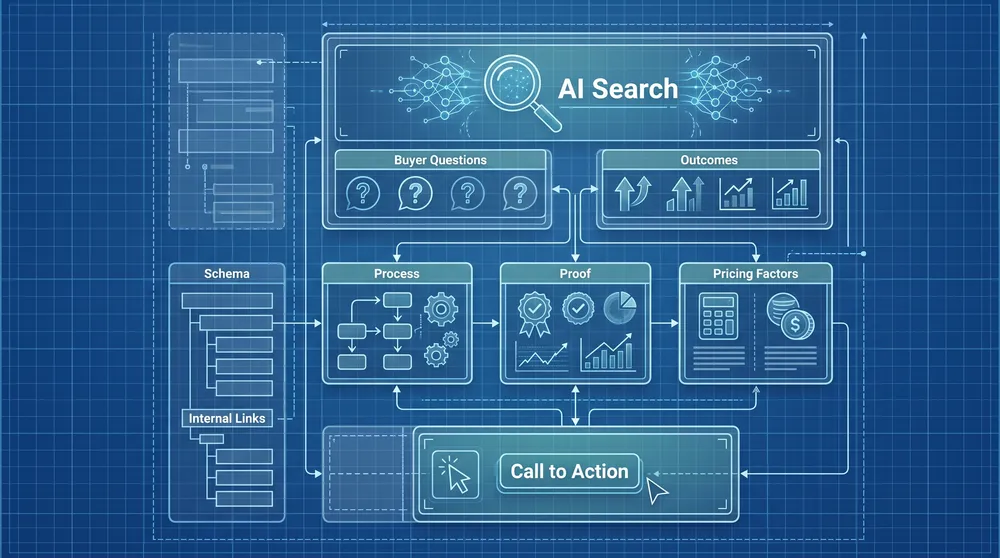
Build the Page Around Buyer Decisions
AI search visibility improves when the service page answers the same practical questions a buyer would ask before making contact.
The Ideal Service Page Anatomy
Use these sections as a repeatable template for every important service page.
Above the Fold
State the service, location or audience, main outcome, proof point, and primary call to action within the first viewport.
Service Scope
Explain what is included, what is excluded, who it suits, who it does not suit, and what alternatives exist.
Process Steps
Describe how the engagement works from enquiry to delivery, including timelines, inputs, approvals, and handover.
Proof Blocks
Add case studies, testimonials, reviews, certifications, examples, screenshots, project metrics, and team credentials.
Pricing Context
Explain pricing ranges or factors, what changes the cost, and what buyers should prepare before requesting a quote.
Linked Cluster
Connect the service page to related guides, locations, industries, comparisons, FAQs, case studies, and contact pages.
The Recommended Service Page Structure
1. Hero Section: Define the Service Fast
Use the H1 and opening paragraph to explain the service in human language. Include the audience or location if relevant. A strong service page does not start with a vague slogan. It tells buyers and search systems exactly what the page is about.
2. Problem, Outcome, and Fit
Explain the problem the service solves, what success looks like, and who the service is best for. This helps AI systems match the page to buyer prompts such as "best option for", "who can help with", "how to choose", or "service for small business".
3. What Is Included
List deliverables, inclusions, exclusions, tools, support, timelines, and handover. Service pages often fail because they say "we provide expert support" without explaining what the customer actually receives.
4. Process and Timeline
Show the steps from enquiry to completion. Include discovery, proposal, onboarding, delivery, review, launch, support, or maintenance if those steps apply. Process sections make the service easier to trust and easier to cite in answer-style results.
5. Proof, Experience, and Trust
Add proof close to the claims it supports. Use testimonials near outcomes, case studies near process, licences near regulated services, and examples near deliverables. Google’s helpful content guidance puts heavy emphasis on experience, expertise, authoritativeness, and trust.
6. Pricing Factors
You do not always need a fixed price table, but you should explain what affects cost. Include factors such as project size, urgency, locations, integrations, compliance, number of pages, number of stakeholders, complexity, and support level.
7. FAQs That Answer Real Sales Questions
Use FAQs for real buyer concerns, not keyword stuffing. Good service-page FAQs explain timeline, price range, warranty, preparation, eligibility, service areas, guarantees, ownership, reporting, and what happens after enquiry.
8. Related Services and Next Steps
End with contextual internal links and a clear call to action. Link to complementary services, guides, industries, locations, pricing, and case studies. Google’s SEO starter guide notes that links help users and search engines discover and understand connected pages.
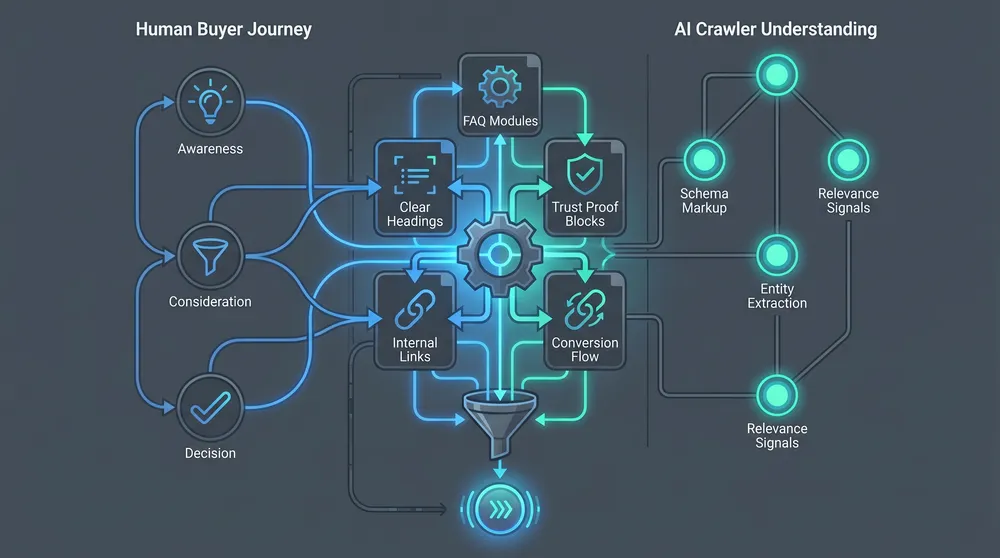
Schema and Technical Setup
Do not add schema that says more than the visible page. Google’s structured data guidance repeatedly asks site owners to validate markup, make sure pages are accessible to Google, and keep structured data aligned with visible content.
For service pages, useful structured data patterns may include:
- Organization: business identity, logo, contact information, sameAs profiles, identifiers, and administrative details.
- LocalBusiness: location pages, service-area businesses, opening hours, phone numbers, addresses, and departments where relevant.
- BreadcrumbList: page hierarchy and context inside the site structure.
- FAQPage: only where the content fits Google’s current FAQ guidelines and the questions and answers are visible on the page.
- Product or Offer: only when the service is packaged like a product or has a clear purchasable offer that fits Google’s product documentation.
- Service schema.org markup: useful for machine-readable clarity, even though it is not a special Google AI Overview requirement or guaranteed rich result trigger.
Internal Linking Pattern
Every core service page should sit inside a cluster. Link from the homepage, main services page, relevant guides, industry pages, location pages, and case studies. Link out from the service page to related services, comparison guides, pricing explainers, proof pages, and contact pathways.
Use descriptive anchor text. Instead of "learn more", use links such as "custom web design for tradies", "Shopify SEO migration checklist", or "AI search visibility audit". Clear anchor text helps users and search systems understand the target page before they click.

Measure AI Visibility by Service Category
Track each service page against the real prompts buyers use, then compare AI mentions, citations, organic search performance, and conversions.
Recommended Setup by Maturity
Foundation
Use a manual service page framework, Google Search Console, GA4, Rich Results Test, PageSpeed Insights, Google Business Profile, and a spreadsheet of buyer prompts. This is the best starting point for most service businesses.
Early Monitoring
Add a lightweight AI visibility or content workflow when you need prompt tracking, service-page content briefs, competitor context, or recurring reporting.
Active Growth
Add broader tracking and optimization when service-page visibility is a monthly KPI and the team needs repeatable content briefs, citation checks, and share-of-voice monitoring.
Advanced Operations
Use larger AI visibility, SEO, content, or agency workflows when you manage many services, locations, industries, content teams, or competitors. At this level, plan for implementation and reporting time, not only tool selection.
Common Mistakes
- Writing a service page that says what the business does but not who the service is for.
- Hiding process, pricing factors, and proof behind a sales call.
- Using the same generic copy across every service and location page.
- Adding schema that does not match visible content.
- Ignoring internal links from guides, case studies, locations, and related services.
- Publishing FAQs that repeat keywords instead of answering buyer objections.
- Tracking rankings but not AI mentions, citations, qualified leads, or conversion quality.
- Buying AI visibility software before fixing thin content and crawlability.
Final Recommendation
Structure service pages as decision-support pages, not brochure pages. Define the service clearly, answer the questions buyers and AI systems need resolved, show proof, explain process and pricing factors, add honest structured data, and connect the page to a wider topic cluster.
The page that wins in AI search is usually the page that removes the most uncertainty. If a buyer can understand the service, compare it, trust it, and act on it, AI systems have a stronger reason to surface and cite it.
Sources Checked
- Google Search Central - AI features and your website
- Google Search Central - helpful, reliable, people-first content
- Google Search Central - SEO starter guide
- Google Search Central - LocalBusiness structured data
- Google Search Central - Organization structured data
- Google Search Central - FAQPage structured data
- Schema.org - Service type
- Screaming Frog SEO Spider features
- Frase product information
- Semrush AI Visibility Toolkit documentation
- Ahrefs Brand Radar documentation
- Ahrefs Custom Prompts product information
- OtterlyAI product information
- Scrunch product information