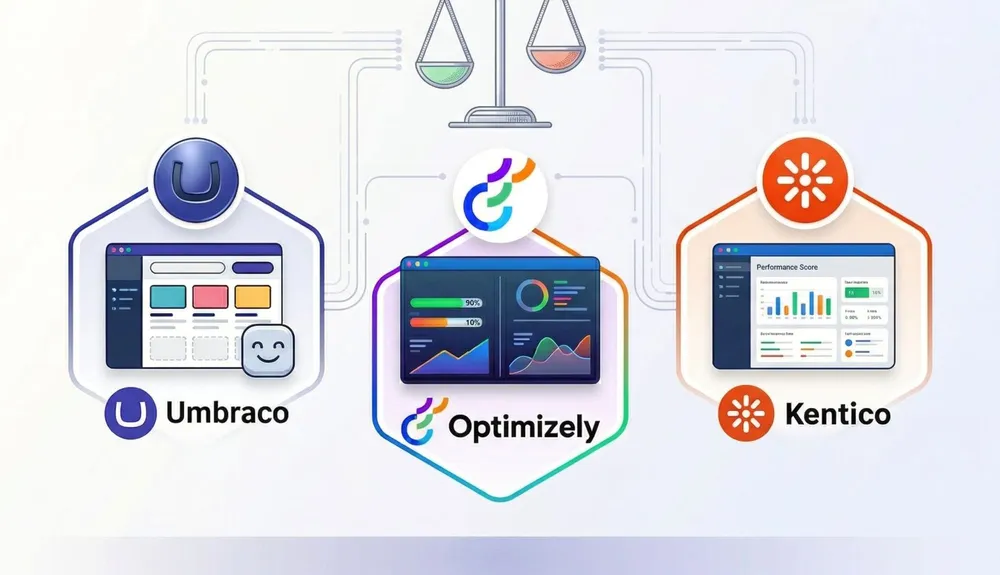
Preparing Umbraco and Kentico for Agentic Commerce in 2026
Learn how to prepare Umbraco and Kentico websites for agentic commerce in 2026 by improving content structure, product data, APIs, governance, and multi-channel delivery.
Agentic commerce is moving from concept to implementation. On January 11, 2026, Google announced the Universal Commerce Protocol and positioned it as an open standard for shopping journeys that run from discovery to buying and post-purchase support. That does not mean every Australian business needs autonomous checkout tomorrow. It does mean CMS and commerce teams should start preparing their websites and data models now.
For Umbraco and Kentico teams, the main question is not whether an AI agent will write product descriptions or answer support questions. The harder question is whether your website can expose trustworthy, machine-readable product and service information, keep that information fresh, connect it to commerce logic, and do so with enough governance that an agent-driven journey does not damage the customer experience.
This guide explains what preparation looks like in practice for Umbraco and Kentico websites in 2026. It is about readiness: structured content, product data, API design, identity, workflow, and operational control.
What Agentic Commerce Readiness Actually Requires
Neither Umbraco nor Kentico becomes agent-ready because you add a chatbot. Readiness comes from how content, product data, channels, and checkout systems are structured underneath.
Structured Content
Products, services, policies, FAQs, and promotional content need reusable fields instead of being trapped inside long rich-text pages.
Fresh Commerce Data
Prices, stock status, shipping promises, variants, and returns rules need controlled updates and clear ownership.
Stable APIs
Agents and AI surfaces depend on reliable APIs, headless delivery, and integration points rather than manual page scraping.
Identity and Checkout
Authentication, permissions, payment flow, and seller-of-record boundaries need to be defined long before autonomous checkout is switched on.
Channel Governance
Web, email, and headless channels need consistent rules so content does not drift across storefronts and AI surfaces.
Operational Control
Teams need approval paths, auditability, rollback, and testing for AI-assisted experiences and product updates.
What Changed in 2026
The biggest change is not just better AI chat interfaces. It is the emergence of technical standards and retailer tooling designed specifically for agent-led shopping.
Google's January 11, 2026 announcement introduced UCP as a new open standard for agentic commerce and said it would support the shopping journey from discovery to post-purchase support. Google's companion UCP documentation shows the protocol covering catalog search and lookup, cart building, identity linking, checkout, and order management. Google also said UCP would soon power checkout on eligible U.S. retailer listings in AI Mode and the Gemini app, with global expansion planned in the coming months.
That matters for CMS and commerce architecture because it shifts the readiness question. A website is no longer only a place where people browse pages. Increasingly, it is a data and transaction surface that needs to be understandable to systems acting on a shopper's behalf.
The practical implication for Australian businesses is straightforward: prepare for machine-to-system interaction even if your primary sales experience remains human-led today.
What an Agent-Ready CMS Stack Needs
UCP and similar commerce patterns are useful because they make the hidden requirements visible. If your commerce experience needs catalog search, identity linking, checkout, and order management, your CMS must support those experiences with clean upstream content and data.
| Requirement | Why it matters for agentic commerce | What to check in your stack |
|---|---|---|
| Structured product and service content | Agents work best with clear fields, attributes, and linked entities. | Can you separate products, variants, benefits, policies, and CTAs into reusable models? |
| Channel-aware delivery | The same information may need to appear on web, email, headless surfaces, and AI-driven interfaces. | Can your CMS serve multiple channels without duplicating content manually? |
| API and integration readiness | AI shopping flows depend on APIs, not only rendered pages. | Do you have headless delivery, webhooks, and clear integration points into commerce and search systems? |
| Freshness and governance | Agents amplify stale data problems quickly. | Who owns updates to pricing, stock, shipping, returns, and legal copy? |
| Trust and control | Autonomous experiences need auditable boundaries. | Can you test, review, roll back, and control what an AI-assisted flow exposes? |
The CMS does not need to do every part of commerce itself. It does need to provide clean, governed inputs to the systems that do.
How to Prepare Umbraco for Agentic Commerce
As of June 20, 2026, Umbraco's official lifecycle page lists Umbraco 17 as the current LTS release. It was released on November 27, 2025, supports .NET 10 LTS, and remains in support through November 27, 2028. For commerce teams, that stability matters because agentic commerce is not a one-quarter experiment. It needs a platform that can be maintained while integrations evolve.
1. Start from a supported, API-ready Umbraco baseline
Umbraco's product documentation highlights built-in headless capabilities, the Content Delivery API, API-driven flexibility, and support for integrations through APIs and webhooks. If your current build is old, tightly coupled, or overloaded with page-specific logic, start by reducing that technical debt before you chase agent experiences.
2. Refactor page content into reusable commerce content types
Move product and service information out of page-specific WYSIWYG content and into reusable models for features, variants, specifications, FAQs, shipping promises, return rules, and merchandising messages. Agentic commerce depends on extractable facts, not clever layout alone.
3. Separate editorial content from transaction systems
Umbraco can support e-commerce through add-ons and integrations, but the safe pattern is still separation of concerns. Let Umbraco manage content, merchandising, and supporting information while your commerce engine, ERP, or order system owns pricing, inventory, checkout, and fulfilment logic. Then define the integration layer clearly.
4. Use governance features to reduce freshness risk
Umbraco's version control, audit trails, scheduled publishing, and cloud deployment workflows are useful here. They do not make commerce data accurate by themselves, but they help teams control when information changes, who changed it, and how updates move through environments.
5. Prepare for AI-assisted discovery, not only checkout
Even before agentic checkout matters to you, your Umbraco site should be able to answer product and service questions cleanly. That means improving content structure, schema, FAQs, comparison data, and service page clarity now, so AI discovery surfaces have higher-quality inputs later.
How to Prepare Kentico for Agentic Commerce
Kentico's current documentation already reflects the kind of multi-channel operating model that agentic commerce needs. Its SaaS overview says Xperience by Kentico lets teams manage multiple digital content delivery channels including website, email, and headless. That matters because an agent-ready commerce stack needs one source of governed content that can travel across multiple surfaces.
1. Design your channel model deliberately
If your Kentico project treats web, email, and headless delivery as separate content silos, fix that first. Channel sprawl creates contradictory messages, stale offers, and duplicated updates. Agentic experiences expose those inconsistencies fast.
2. Strengthen the content model around products and reusable entities
Kentico's documentation emphasizes content modeling, reusable field schemas, and content hub patterns. Those are the right tools for separating product attributes, supporting content, policy content, and landing-page presentation from one another. Use them. Do not let product knowledge live only inside Page Builder copy.
3. Use KentiCopilot to accelerate cleanup and modeling work
Kentico describes KentiCopilot as a suite of AI development tools for Xperience by Kentico projects, built around MCP servers, workflows, and best practices. Its documentation specifically calls out content type analysis, content modeling support, widget implementation, and product display patterns. That is valuable in preparation work because agentic commerce readiness often starts with model analysis and repetitive restructuring rather than brand-new feature invention.
4. Keep the Management API and headless patterns intentional
KentiCopilot's Management MCP server can query and edit the system's object model and Page Builder data, which is useful for implementation workflows. In production architecture, the real goal is disciplined exposure: clear APIs, approved flows, and predictable ownership between Kentico content, search, merchandising, and transaction systems.
5. Treat AI assistance as development leverage, not a governance shortcut
KentiCopilot can speed up modeling and implementation, but the business still needs rules for what content is authoritative, which data is sourced from commerce systems, and who approves customer-facing changes.
The Common Gaps That Usually Block Agentic Commerce
- Product knowledge is trapped in page copy. Agents need fields, entities, and relationships.
- The CMS and commerce platform disagree. If product copy, shipping promises, or availability differ across systems, trust breaks quickly.
- Headless is enabled but not governed. APIs without ownership, documentation, or versioning become fragile fast.
- Promotions and policies are manual. Agentic shopping surfaces need reliable, current rules for offers, returns, and fulfilment.
- Identity and seller-of-record boundaries are fuzzy. Google and UCP position retailers as the seller of record. Your architecture needs that same clarity.
- Teams confuse AI features with readiness. A branded assistant or chatbot does not fix weak content models, stale data, or poor workflow discipline.
If any of those conditions exist, the right move is usually not to launch a big AI shopping experience. It is to repair the foundation first.
A Practical 90-Day Preparation Plan
Days 1 to 30: Audit the current state
- Inventory product, service, policy, and FAQ content across your CMS and commerce systems.
- Identify where prices, availability, shipping, and returns data actually originate.
- Review whether your Umbraco or Kentico content model exposes reusable fields or hides key facts inside page layouts.
- Map every API and integration point that would matter for search, discovery, checkout, and post-purchase support.
Days 31 to 60: Fix the model and governance
- Refactor high-value content types around reusable entities and product attributes.
- Define ownership for promotions, product data, policy text, and legal or compliance content.
- Document channel rules for website, email, headless delivery, and AI-assisted experiences.
- Decide which data remains CMS-owned and which must always be sourced from the commerce platform or ERP.
Days 61 to 90: Prepare the delivery layer
- Strengthen APIs, documentation, and validation around product and service data.
- Test AI-friendly discovery experiences before autonomous checkout.
- Validate auditability, rollback, approvals, and environment controls.
- Create a roadmap for UCP-style integration, native checkout, or branded AI-agent experiences only after the foundation is stable.
This sequence is deliberately conservative. It reduces the risk of launching impressive demos on top of unreliable content and brittle integrations.
Frequently Asked Questions
Short answers for teams planning Umbraco or Kentico readiness work in 2026.
Sources Checked
Prepare the CMS Before You Add the Agent Layer
VaniTech can help audit your Umbraco or Kentico setup, restructure content models, and plan the API and governance work needed for AI-ready commerce.