
Global Factory
Build a factory economy from the ground up. Mine resources, manufacture products, manage stock, trade through markets, complete contracts, and research your way into advanced industry.
What is Global Factory?
A mobile industrial management game where every product has a supply chain.
Global Factory is Vanitech's mobile factory management game where players build an industrial operation from the ground up. The experience starts with a country-based company profile, then grows through mining, production, inventory planning, market trading, contracts, and university research.
The core promise is simple: every product has a supply chain. Players extract raw materials, turn them into useful components, manufacture higher-value goods, sell into local or global markets, and reinvest the profit into better infrastructure.
Early decisions are small and practical, such as collecting iron ore or producing iron ingots. Over time, the same system expands into advanced manufacturing, automation, consumer products, electric vehicles, robotics, and high-value contracts.
A compact industrial economy
Mining, manufacturing, storage, markets, contracts, and research all affect one another.
Main gameplay systems across factory, mine, market, warehouse, university, and contracts.
6
Country-based mine profiles shape what each player can extract directly.
1
Local and global markets help fill resource gaps and turn surplus into cash.
2
University research unlocks stronger products, systems, automation, and upgrades.
6+
What players do
Global Factory is designed around connected, practical decisions that build toward larger industrial goals.
Choose a country
Start with a virtual country that shapes available mine resources and market dependencies.
Build mines
Extract account-available raw materials and upgrade capacity and output over time.
Manufacture products
Use factory lines to produce components, materials, and finished goods from stored inventory.
Manage stock flow
Track owned stock, incoming deliveries, outgoing sales, and warehouse capacity limits.
Trade resources
Buy shortages and sell surplus through local and global markets with timed deliveries.
Complete contracts
Deliver requested goods to earn cash, gold, and reputation.
Invest in research
Unlock new products, automation systems, researchers, build skills, and market capabilities.
Speed up progress
Use normal clicks and Power Click boosts for production, mining, research, and construction.
The game loop
Every area feeds the next, so progress feels like operating a small but connected industrial economy.
- Mine raw materials.
- Store resources in the warehouse.
- Manufacture products in factory lines.
- Buy shortages or sell surplus through the market.
- Complete contracts for rewards and reputation.
- Research new capabilities at the university.
- Upgrade factories, mines, warehouse capacity, and research systems.
A factory order can pause when warehouse ingredients are missing. A market purchase creates an incoming delivery instead of instant stock. A warehouse limit can block collection. Research unlocks new products and higher production tiers. The result is a connected economy rather than a set of disconnected screens.
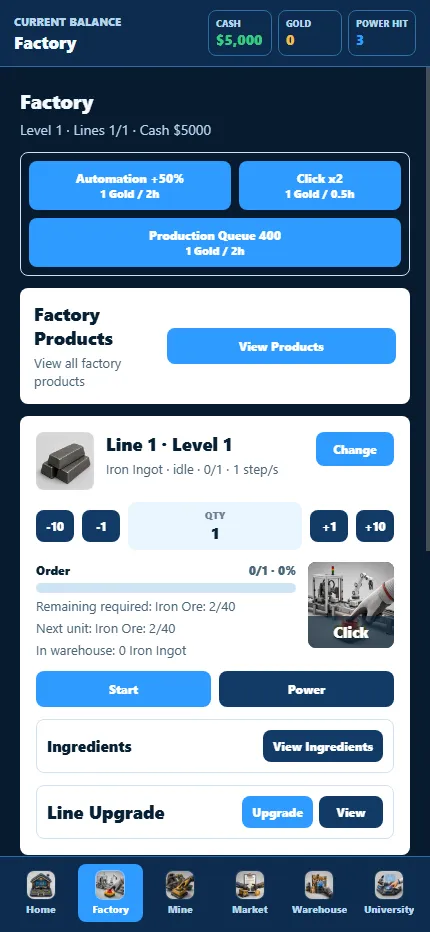
Factory
The Factory screen is where raw inventory becomes useful products. Players select products, set quantities, review ingredient requirements, start production, and click or boost progress.
Factory lines have levels, product requirements, upgrade paths, and production queues, so scaling manufacturing is both a timing problem and a planning problem.
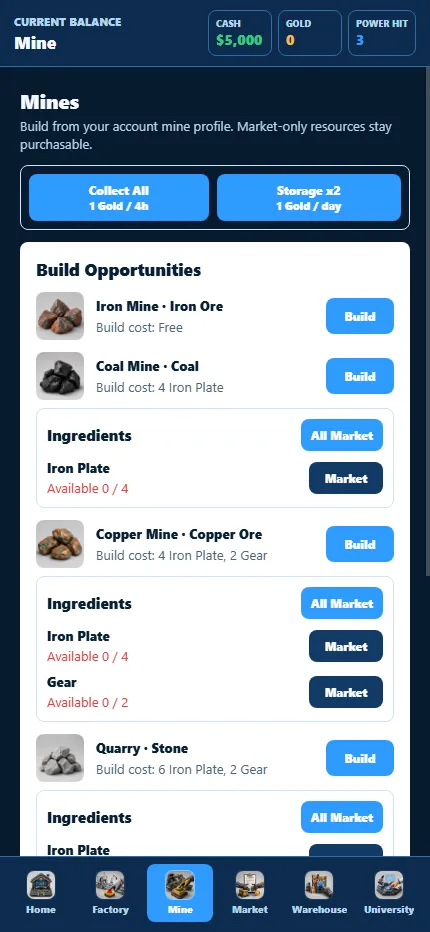
Mine
The Mine screen controls extraction. Players build from the country-generated mine profile, collect stored resources, and upgrade mine capacity and output.
Resources that are not available through the player's country profile remain obtainable through the market, keeping each country start distinct without blocking progression.
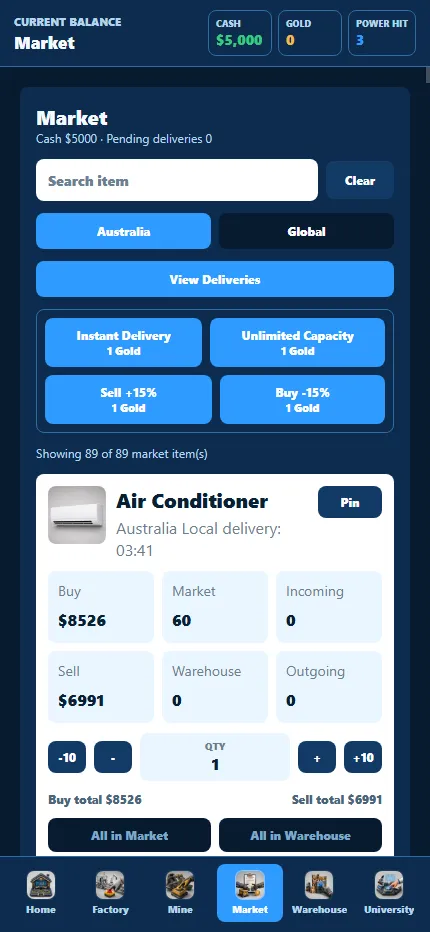
Market
The Market screen connects the player economy to local and global trade. Players can search and pin products, compare buy and sell prices, choose quantities, buy missing materials, sell warehouse stock, and manage timed deliveries.
Local markets are faster, while global markets broaden access and create a larger logistics layer.
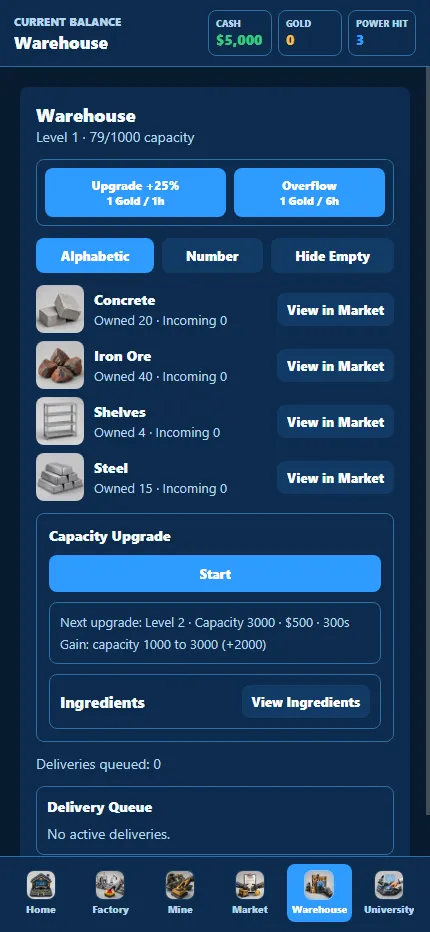
Warehouse
The Warehouse screen makes inventory visible and actionable. It tracks owned stock, incoming goods, outgoing sales, used capacity, and upgrade requirements.
Because production, mining, contracts, and market deliveries all touch inventory, the warehouse becomes the player's main control point for capacity and flow.
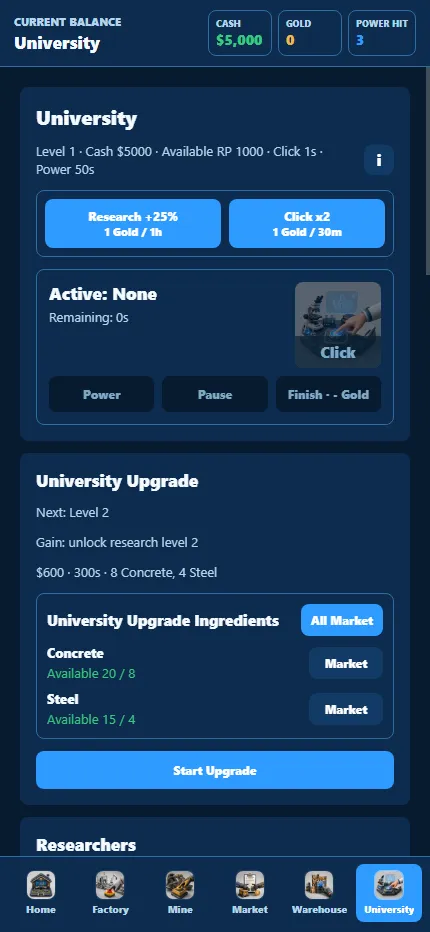
University
The University screen drives progression. Research unlocks new products, better infrastructure, automation systems, researchers, build skill improvements, and market capabilities.
Players can advance research through time, clicks, and Power Click boosts, then reinvest into university upgrades to reach higher tiers.
Progression fantasy
From small factory floor to global manufacturing network.
Global Factory starts with small industrial actions and grows into a national-scale manufacturing network. The player begins by managing starter resources and simple production, then gradually unlocks stronger lines, better mines, larger storage, smarter market access, and more advanced product chains.
The long-term fantasy is to move from a small factory floor to a global operation capable of producing complex goods such as electric motors, smart terminals, mining rigs, factory robots, precision assemblers, delivery vans, and electric buses.
The visual direction is industrial, readable, and practical: dark navigation surfaces, bright action states, product imagery, compact cards, large action buttons, and screen layouts that support repeated play.
Global Factory questions
A quick overview of the game's systems and player progression.
Built by Vanitech
Global Factory brings Vanitech's practical product thinking into a mobile factory management game with connected systems and clear progression.