
AI-Ready Service Pages: How to Turn Your Website into the Source AI Tools Trust
An AI-ready service page is a service page that clearly explains what you do, who you help, where you operate, how the service works, what proof supports your claims and what a customer should do next. It is written for people first, but structured so search engines and AI tools can understand it without guessing.
For service businesses, this matters because customers are no longer only comparing ten blue links. They may ask Google AI Overviews, ChatGPT Search, Microsoft Copilot or another assistant to recommend a provider, compare options, explain what a company does or summarise whether a business is credible.
If your service page is vague, thin or disconnected from proof, AI systems may describe the service poorly, miss the page entirely or rely on another source. If the page is clear, crawlable, current and well supported, it has a better chance of becoming the source AI tools trust.
The Short Answer
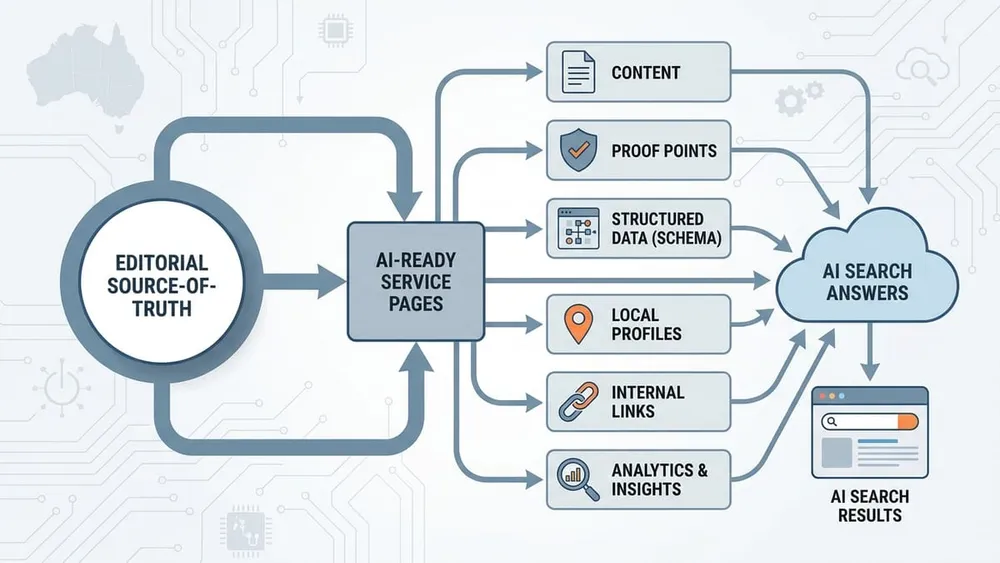
To make a service page AI-ready, turn it into a source-of-truth page. Define the service in plain language, answer the questions buyers ask before contacting you, show real proof, add schema that matches visible content, keep business details consistent, link related pages together, allow the search crawlers you want, and measure whether the page is cited or visited from AI-assisted discovery.
This is not a shortcut around SEO. Google says its AI features in Search still rely on core Search ranking and quality systems, and the same SEO fundamentals remain relevant.
What Makes a Service Page AI-Ready?
An AI-ready page removes ambiguity. It gives customers and AI systems the same clear facts, proof and next steps.
Clear Definition
Name the service, describe the customer problem, explain the outcome and avoid generic phrases such as digital solutions or end-to-end transformation.
Buyer Questions
Answer cost factors, timelines, inclusions, exclusions, risks, alternatives, locations, prerequisites and what happens after enquiry.
Proof
Use case studies, examples, screenshots, process details, testimonials, credentials, reviews and source links where they genuinely support the claim.
Machine-Readable Context
Add accurate structured data, breadcrumbs, author or organisation details and crawlable media that match what users can see on the page.
Entity Consistency
Keep service names, locations, business details, profiles, reviews and directory listings aligned so systems can connect the service to the right provider.
Measurement
Track Search Console performance, Bing AI Performance, analytics referrals, server logs and repeated AI prompts for important service queries.
Why Service Pages Matter in AI Search
AI search systems often answer practical, commercial questions: who provides this service, what is included, which provider works in this location, what option is better and what should a buyer consider before making contact.
Your service pages are the pages most likely to answer those questions. They should not be treated as shallow conversion pages or keyword targets. They should be the most complete, accurate and useful explanation of each service your business wants to be known for.
Google's guidance for AI features says the same foundational SEO practices apply: pages should be crawlable, findable through internal links, useful, textually clear, supported with relevant media and backed by structured data that matches visible content. Google also says a page must be indexed and eligible to show a Search snippet to be eligible as a supporting link in AI Overviews or AI Mode.
OpenAI's publisher guidance says public websites can appear in ChatGPT Search and that publishers should not block OAI-SearchBot if they want content discoverable, surfaced, cited and linked. Microsoft Bing Webmaster Tools now reports how content is cited in supported AI-generated answers through AI Performance, including cited URLs and grounding queries.
The practical conclusion is simple: if a service page is vague, technically blocked, light on proof or disconnected from the rest of your website, it is a weak source. If it is clear, specific, current and easy to verify, it becomes more useful to customers and more understandable to AI tools.
The AI-Ready Service Page Framework
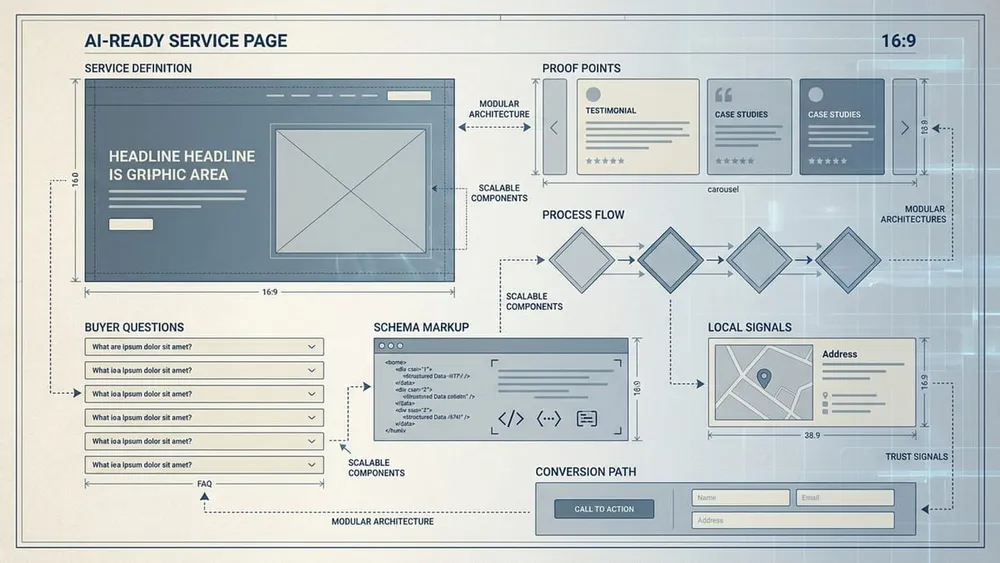
Use this framework for every important service page. It is not about making every page longer. It is about giving the page the facts, context and proof needed for a buyer or answer engine to understand the service.
Build Around Decisions, Not Keywords
A trusted service page explains the service, proves capability, answers objections, clarifies location and gives the customer a low-friction next step.
1. Start with a direct service definition
The first screen should tell the reader exactly what the service is, who it is for, where it is available and what outcome the customer can expect. Avoid vague phrases that could apply to any competitor.
Weak: "We deliver innovative digital solutions for growth." Better: "VaniTech builds small business websites, CMS platforms, integrations and SEO-ready digital products for businesses in Melbourne and across Australia."
The better version gives AI systems named entities, service categories, audience context and location signals to work with.
2. Explain the problem the service solves
A service page should connect the offer to a real customer problem. For example, a CMS migration page should explain the symptoms of an ageing CMS, the risks of unsupported platforms, the content and integration issues involved and what a successful migration looks like.
AI tools often summarise pages around user intent. If the page only describes your company, it may not match customer questions. If it explains the problem clearly, it is easier to connect the service to relevant prompts.
3. Show what is included and excluded
AI summaries become more accurate when scope is explicit. List the main deliverables, typical exclusions, optional add-ons and assumptions.
| Service detail | Why it helps users | Why it helps AI systems |
|---|---|---|
| Inclusions | Buyers know what they receive. | The page can be matched to specific service needs. |
| Exclusions | Buyers avoid false assumptions. | Summaries are less likely to overstate what you do. |
| Inputs required | Buyers understand what to prepare. | The process is easier to describe accurately. |
| Optional add-ons | Buyers can compare packages. | Related services can be associated without confusing the core offer. |
4. Answer commercial questions directly
Customers ask practical questions before they contact a service provider. Your page should answer them clearly:
- How much does this usually cost, or what affects cost?
- How long does it take?
- Who is this service best suited for?
- What is the process?
- What are the risks?
- What platforms or technologies are used?
- What happens after launch?
- What should a customer prepare before the first call?
Google's helpful content guidance encourages content created to benefit people, not content created primarily to manipulate rankings. Direct buyer answers are usually good for both conversion and AI search visibility because they make the page genuinely useful.
5. Add proof that cannot be copied by a generic article
Trust grows when the page includes evidence. Add case studies, examples, implementation notes, screenshots, diagrams, migration checklists, technical decisions, review snippets, before-and-after metrics where verified, team credentials and links to relevant work.
Google's generative AI guidance specifically recommends valuable, non-commodity content with a unique point of view or first-hand experience. A generic service page that repeats the same claims as every competitor gives AI systems little reason to trust or cite it.
Six Signals Every Service Page Should Strengthen
Use these signals to make the page easier to verify, easier to cite and harder to misinterpret.
Entity Clarity
Use consistent business name, service names, locations, contact details and profile links.
Visible Expertise
Name the experience, methods, platforms, constraints and decisions behind your delivery.
Evidence
Support claims with examples, case studies, reviews, images, technical notes or source links.
Crawl Access
Keep priority service pages indexable, linked, sitemap-listed and available as readable text.
Structured Data
Use schema to describe visible page content, not to add hidden claims or fake authority.
Freshness
Update services, technology versions, prices, examples, FAQs, screenshots and schema when facts change.
6. Use structured data as a clarity layer
Structured data can help search engines understand the entities and relationships on a page. For service pages, useful schema can include Organization, LocalBusiness, Service, WebPage, BreadcrumbList, FAQPage and Review only where compliant and visible.
Google's structured data policy is clear: markup should represent the visible content of the page, should be relevant to that page and does not guarantee a rich result. Treat schema as a machine-readable summary of what the page already says, not a place to hide extra claims.
7. Make the page technically accessible
Before rewriting the content, make sure the service page can be discovered and read. Check:
- the URL returns a successful status code;
- the page is not blocked by
robots.txt, meta robots orX-Robots-Tagheaders; - the canonical URL is correct;
- the page is linked from navigation, parent service pages or related articles;
- the page appears in the XML sitemap;
- important content is visible as text, not trapped in images or inaccessible scripts;
- the page is usable on mobile;
- forms, phone links and quote buttons work.
Google says Search Console can help website owners understand how Google crawls, indexes and serves pages. Use URL Inspection on priority service pages after major changes.
8. Connect service pages with internal links
AI-ready service pages should not sit alone. Link each service page to related services, supporting articles, case studies, industry pages, FAQs and the contact pathway.
For example, a CMS service page might link to Umbraco development, Contentful development, Contentstack development, integration services, relevant migration articles and contact. The article pages should link back to the commercial service page they support.
9. Align local and external business signals
For local service businesses, your service pages should match your external profiles. Google says local results are mainly based on relevance, distance and prominence, and that complete, accurate Business Profile information helps Google understand relevance.
Keep your Google Business Profile, Bing Places, LinkedIn, directory listings, review platforms, website footer and contact page aligned on the business name, categories, address or service area, phone number, website URL, opening hours and service descriptions.
10. Add media that explains the service
Google's AI feature guidance says textual content can be supported with high-quality images and videos when relevant. For service pages, useful media might include process diagrams, interface screenshots, architecture sketches, team photos, before-and-after examples, short explainer videos and project imagery.
Use descriptive file names, useful alt text, captions where appropriate, compressed formats and transcripts for videos. Do not put critical service details only inside an image.
11. Build a refresh and monitoring routine
A page can be AI-ready at launch and become stale later. Review priority service pages quarterly, or sooner when services, pricing, tools, technologies, team details or case studies change.
Use Google Search Console, Bing Webmaster Tools, analytics referral data, server logs and repeat AI prompt testing. Bing AI Performance can show cited pages and grounding queries across supported Microsoft AI experiences. OpenAI says ChatGPT referral URLs include utm_source=chatgpt.com, which can help publishers track ChatGPT traffic in analytics tools.
AI-Ready Service Page Checklist
- The page has one clear primary service topic.
- The first screen explains what the service is, who it helps and where it is available.
- The page answers common buyer questions about cost, time, process, scope and risks.
- Inclusions, exclusions and optional add-ons are easy to scan.
- Proof is visible through examples, case studies, reviews, credentials or screenshots.
- Business name, service name and location details match external profiles.
- Important content is visible as readable text.
- The page is crawlable, indexable and linked from relevant pages.
- The page is included in the XML sitemap.
- Structured data matches visible content.
- FAQ content is visible before FAQ schema is added.
- Images have descriptive file names and meaningful alt text.
- The page links to related services, articles, case studies and contact options.
- The call to action tells users what happens next.
- Search Console and analytics are checked after major updates.
- AI prompts are tested monthly for important service queries.
Common Mistakes to Avoid
- Creating one generic services page: AI systems and customers need specific pages for specific services.
- Writing only for keywords: The page should answer buyer decisions, not repeat a phrase.
- Adding schema before fixing content: Structured data clarifies visible content; it does not replace it.
- Hiding important facts in images: Critical service information should be text on the page.
- Using proof that is too vague: "Trusted by businesses" is weaker than a specific case study, process or result.
- Letting pages go stale: Old tools, screenshots, prices and platform versions reduce trust.
- Blocking useful crawlers by accident: Review robots.txt, CDN rules and firewall settings.
How VaniTech Can Help
VaniTech can review priority service pages for AI search visibility, content clarity, structured data, internal linking, technical crawlability, local SEO consistency and conversion quality. This works well alongside SEO, schema, AEO and GEO services, small business website solutions and CMS implementation services.
If your website already has service pages, the first step is usually an audit: identify which pages should become source-of-truth pages, what facts are unclear, what proof is missing, what schema is inaccurate and which related pages should link together.
Final Recommendation
AI-ready service pages are not about writing for robots. They are about making the most important commercial pages on your website clearer, more useful and easier to verify.
When a service page explains the offer, answers real questions, shows proof, uses accurate schema, connects to related pages and stays current, it becomes a stronger source for customers and AI tools. That is the kind of page worth building: not longer for the sake of length, but clearer because the business deserves to be understood correctly.
AI-Ready Service Page FAQs
Answers to common questions about building service pages that AI search tools can understand and cite accurately.
Sources Checked
- Google Search Central - AI Features and Your Website
- Google Search Central - Optimizing Your Website for Generative AI Features on Google Search
- Google Search Central - General Structured Data Guidelines
- Google Search Central - Creating Helpful, Reliable, People-First Content
- Google Search Central - Get Started with Search Console
- Google Search Central - Learn About Sitemaps
- Google Business Profile Help - Tips to Improve Your Local Ranking on Google
- OpenAI Help Center - Publishers and Developers FAQ
- Bing Webmaster Tools - AI Performance
Turn Your Service Pages into Trusted Source Pages
VaniTech can review your service pages for AI search visibility, content clarity, schema, local trust signals, crawlability and conversion paths.