
Umbraco Hosting in 2026
Plesk, Azure, AWS, Umbraco Cloud, and Heartcore Compared
Choosing the right Umbraco hosting setup in 2026 is no longer just a technical decision. It affects your monthly cost, deployment speed, editor experience, scalability, security responsibilities, and how easily your team can maintain the platform over time. The good news is that Umbraco CMS itself is free and open source, can run on your own infrastructure or in the cloud, and supports both traditional and headless delivery. The challenge is selecting the hosting model that best matches your team, budget, and business goals.
For most standard business websites, the safest default choice in 2026 is Umbraco Cloud because it bundles managed hosting, deployments, environments, and automated upgrade tooling into a platform built specifically for Umbraco. For organizations that need deeper infrastructure control, Azure self-hosting is usually the smoothest custom route. AWS is absolutely possible and can be a good idea, but mostly when the business is already AWS-native and prepared to own more architecture and operational complexity. Plesk is best seen as a practical control-panel-based self-hosting approach for simpler or lower-budget deployments. Umbraco Heartcore is the right answer when the project is truly headless and multi-channel, not when you only need a normal website.
First, an important distinction: hosting Umbraco CMS vs using Heartcore
Umbraco CMS is the open-source core product. You can self-host it, run it on Azure or AWS, or use Umbraco Cloud. Umbraco Cloud is managed hosting for the regular Umbraco CMS. Heartcore is different: it is Umbraco's fully managed headless CMS, delivered through APIs and designed to publish content to any frontend, app, or device. That means Heartcore should be compared not only as a hosting option, but as a different architectural choice.
Cost snapshot in 2026
Here is the most practical way to think about cost in 2026: compare the platform fee first, then add the hidden operational cost of people, maintenance, monitoring, support, and deployment complexity.
Umbraco Cloud starts at €45/month for Starter, €280/month for Standard, and €730/month for Professional in 2026. Dedicated-resource options increase the price significantly, from €230/month for Starter Dedicated 1 up to €2,000/month for Pro Dedicated 3. Extra environments also add cost.
Umbraco Heartcore starts at €60/month for Starter, €300/month for Standard, and €1,100/month for Professional, with Enterprise at €88,000/year in the 2026 pricing update. Heartcore hosting on Umbraco Cloud is included in the product price.
Plesk is cheaper at the license layer, but it is not a full hosting platform by itself. On VPS licensing, Plesk lists Web Admin at 12.04€/month, Web Pro at 18.29€/month, and Web Host at 31.38€/month. However, you still need to pay for the actual server, Windows licensing where applicable, database hosting, backups, monitoring, and support. Plesk also notes that revised pricing affects renewals from January 1, 2026.
Azure self-hosting can look inexpensive at entry level, with Azure App Service on Windows showing B1 at $54.75/month, but that is only the web tier. Umbraco's own Azure guidance says the minimum recommended Azure SQL tier is S2, and Microsoft support can add $29, $100, or $1,000 per month depending on the support level. In real projects, the Azure cost is usually the app plan plus database plus storage plus monitoring plus traffic plus support, not just the web app.
AWS self-hosting has flexible pricing, but cost grows as architecture grows. Elastic Beanstalk has no extra platform fee and charges only for the AWS resources you use. Amazon RDS for SQL Server includes the SQL Server license in the DB price. Application Load Balancer pricing starts at $0.0225 per load balancer-hour plus $0.008 per LCU-hour. AWS Business Support+ starts at $29/month per account, while Enterprise Support starts at $5,000/month. This means AWS can be cost-effective for small carefully designed environments, but it can also become more expensive than expected once you add managed database, load balancing, logging, storage, and support.
Umbraco Cloud
Umbraco Cloud is the most complete managed option for regular Umbraco CMS projects. It includes Microsoft Azure hosting, a managed SQL database, automated upgrades, deployment tooling, Content Flow, and multi-environment workflows built around Git, Kudu, and Umbraco Deploy. Standard and Professional add more environments, SLAs, prioritized resources, and stronger support.
The strongest reason to choose Umbraco Cloud is productivity. Teams do not need to build their own deployment pipeline, patching strategy, or base hosting architecture from scratch. That usually makes Cloud the best fit for agencies, internal digital teams, and marketing-driven websites where speed, stability, and editor workflows matter more than deep infrastructure customization.
The main limitation in April 2026 is that Umbraco Cloud still does not currently support load balancing, and auto-scaling is not available yet, although dedicated worker resources are offered and load balancing is listed on the roadmap with a target release of June 2026. Also, current shared plans run in pooled infrastructure with plan-specific quotas, and Umbraco documents that exceeding CPU or memory quota can restart the application. That makes Cloud excellent for many business sites, but not automatically the best fit for every high-scale or high-availability scenario today.
Best use cases for Umbraco Cloud
Umbraco Cloud is best for brochure sites, brand sites, campaign sites, editorial sites, mid-sized business platforms, and projects where the team wants Umbraco-specific hosting without building a full DevOps function. It is also a strong fit when you want quicker onboarding, safer upgrades, and a more structured content-and-code deployment workflow.
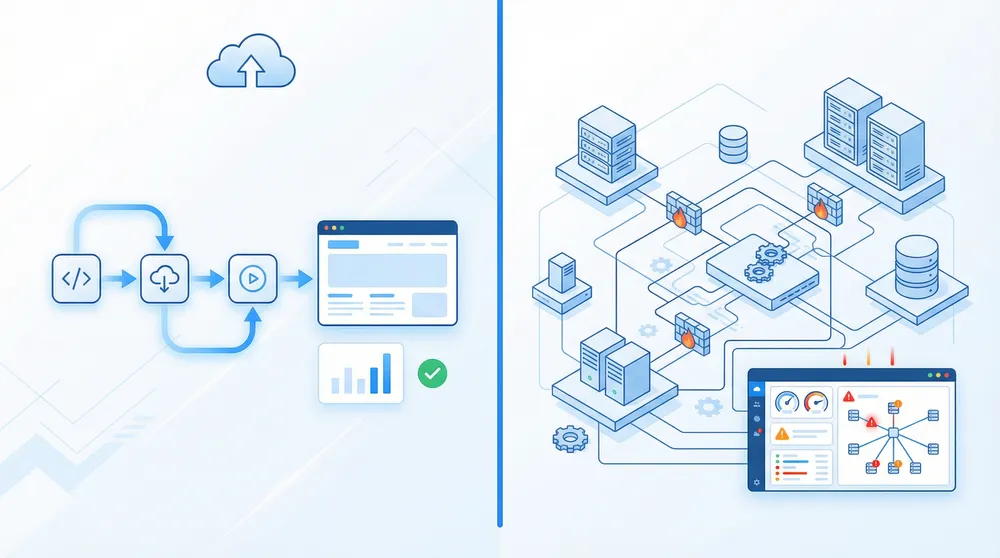
Managed Simplicity vs Infrastructure Control
If your team wants to focus on building Umbraco features instead of managing servers, databases, deployment pipelines, and patching, Umbraco Cloud is usually the strongest option. It gives you managed hosting, environments, deployment tooling, and built-in upgrade workflows.
The tradeoff is control. If you need custom network design, strict infrastructure standards, unusual scaling patterns, or full ownership of every hosting component, self-hosting on Azure or AWS will give you more flexibility.
Self-hosting Umbraco on Azure
Azure is usually the most natural self-hosted destination for Umbraco. Umbraco's documentation explicitly covers Azure Web Apps, recommends Azure-specific configuration, and points to Azure SQL and Azure Blob Storage patterns for media and ImageSharp cache. Azure App Service also gives you a managed platform rather than raw VM administration, which keeps complexity lower than fully manual infrastructure.
Azure is the best self-hosted option when you need more infrastructure control than Umbraco Cloud provides, but still want to stay relatively close to the official Umbraco guidance. It suits organizations that need custom networking, Azure-native security integration, private endpoints, enterprise governance, or more tailored scaling architecture.
The downside is that self-hosting on Azure still means you are responsible for far more than with Umbraco Cloud. You need to own deployment design, observability, database sizing, failover strategy, backups, secrets, network security, scaling rules, and environment consistency. Once you add those responsibilities, Azure can be cheaper than managed Cloud in some cases, but it is not always cheaper in total cost of ownership. That is especially true if the team needs paid Azure support or spends a lot of engineering time maintaining the platform.
Best use cases for Azure
Azure is the best fit for enterprise or upper-midmarket Umbraco builds where the company already uses Azure, wants custom infrastructure, needs stronger integration with Microsoft services, or plans to design its own load-balanced and scalable setup. It is also a good fit when Umbraco Cloud's no-load-balancing limitation is a blocker right now.
Self-hosting Umbraco on AWS
Yes, AWS can be a good idea for Umbraco in 2026, but it is usually a strategic choice rather than the simplest choice. AWS Elastic Beanstalk is designed to help deploy and scale full-stack applications while managing infrastructure operations, and AWS presents it as a good fit for lift-and-shift .NET applications. AWS also offers App Runner, ECS, and Fargate for container-based deployments, and RDS for SQL Server as the managed database layer.
Where AWS makes sense is when the organization is already heavily invested in AWS networking, IAM, monitoring, security tooling, or application architecture. In that situation, forcing Umbraco into Azure just because Umbraco Cloud uses Azure may add more friction than value. An AWS-native team can absolutely run Umbraco well on AWS.
Where AWS is usually a weaker choice is for standard Umbraco projects that simply need a reliable CMS website. Compared with Azure, it is generally less aligned with Umbraco's own hosting guidance, and once you combine app hosting, SQL Server, load balancing, logs, backups, and support, the architecture often becomes more involved than many CMS teams expect. That does not make AWS wrong. It just makes it more appropriate for organizations that already know why they want AWS.
Best use cases for AWS
AWS is best for teams already standardized on AWS, projects that need close integration with broader AWS workloads, or organizations with internal platform engineering capability. It is not the best default recommendation for a typical marketing website or for a client who wants minimal hosting overhead.
Plesk hosting for Umbraco
Plesk is not really a competing cloud platform in the same way as Azure, AWS, or Umbraco Cloud. It is a server control panel. You install it on a server you already rent or own, then use it to manage sites, domains, subscriptions, and server settings. Plesk explicitly says it requires prior installation on a server and distinguishes between VPS and dedicated licensing.
For Umbraco specifically, Plesk can work well because it supports ASP.NET Core on Windows Server, including ASP.NET Core 8, 9, and 10 in current Obsidian versions, and its licensing includes MSSQL-related modules in the listed editions. That makes it a practical path for Windows-based agencies or providers managing several smaller .NET sites.
The real advantage of Plesk is operational convenience for smaller environments. It is often easier for an agency or small hosting team to manage domains, IIS, certificates, mail, backups, and multiple lower-complexity sites through Plesk than through raw cloud architecture. The downside is that Plesk is still self-hosting. You are still responsible for the server, security posture, updates, performance tuning, backup validation, and disaster recovery. It is a good budget and convenience option, not the strongest enterprise-scale answer.
Best use cases for Plesk
Plesk is best for small business sites, low-to-mid traffic Umbraco projects, agencies hosting multiple client sites, and teams that want a familiar control-panel workflow on a Windows VPS or dedicated server. It is much less attractive for high-compliance, autoscaling, or heavily integrated enterprise platforms.

Umbraco Heartcore
Heartcore is the right choice when your project is not just "a website" but a headless content platform. It is a fully managed headless CMS built on Umbraco, with APIs, GraphQL, CDN-backed content delivery, webhooks, and the ability to serve content to any frontend, app, device, or channel. It also includes hosting on Umbraco Cloud at no extra cost.
What makes Heartcore attractive is that it combines Umbraco's editor experience with SaaS-style delivery and headless architecture. That is ideal for omnichannel publishing, composable frontend stacks, or organizations running multiple frontends from a central content hub. Heartcore also includes CDN delivery and automatic upgrades, which removes a lot of operational burden.
The catch is cost and architecture. Heartcore is more expensive than basic Umbraco Cloud plans, and it does not remove the need to host your frontend separately. Since Heartcore delivers content through APIs to websites, apps, and other platforms, the frontend hosting remains your responsibility. In other words, Heartcore simplifies the CMS layer, not your entire digital platform bill.
Best use cases for Heartcore
Heartcore is best for multi-channel publishing, modern frontend stacks, composable architecture, mobile apps, kiosk/device experiences, and organizations that want Umbraco's editing experience without tying presentation to the CMS runtime. It is usually not the most economical choice for a single ordinary company website.

When Heartcore Is Worth the Extra Cost
Choose Heartcore when content needs to power more than one frontend. It is strongest when the same content must serve websites, mobile apps, landing pages, commerce experiences, or other digital channels through APIs.
If you only need a single website rendered by Umbraco itself, Heartcore can add cost and architectural complexity without giving you enough return.
Feature and decision comparison
If you want the lowest operational overhead, choose Umbraco Cloud. It is the best-balanced option for most standard Umbraco builds.
If you want the best custom self-hosted route, choose Azure. It is the most aligned with Umbraco's official guidance and gives you good control without dropping immediately into raw infrastructure complexity.
If your company is already deeply invested in AWS, then AWS can absolutely be a good idea. But it is rarely the simplest answer for a standalone Umbraco site.
If you want the cheapest practical panel-based self-hosting, choose Plesk. Just remember that low license cost does not remove server ownership and maintenance work.
If your project is headless by design, choose Heartcore. If it is not headless by design, do not force Heartcore into the solution just because it sounds modern.
My practical recommendation by use case
For a small to mid-sized corporate or marketing website, I would recommend Umbraco Cloud Standard first, and Plesk second only when budget is tighter and the team is comfortable self-managing a Windows hosting stack.
For an enterprise site that needs infrastructure control, private networking, enterprise governance, or custom scaling, I would recommend self-hosted Azure before AWS unless the organization is already standardized on AWS. That is partly because Umbraco's official hosting guidance is more Azure-oriented and partly because Azure tends to reduce architectural friction for Umbraco teams.
For a business already all-in on AWS, I would recommend AWS with a deliberate architecture, usually not a casual one-server deployment. The team should plan for managed database, deployment approach, observability, backup, and support from day one.
For a true headless multi-channel program, I would recommend Heartcore over trying to assemble a custom headless stack from scratch, especially if editorial usability matters.
For a high-traffic platform that needs horizontal scale today, I would lean toward self-hosted Azure or AWS rather than standard Umbraco Cloud, because Umbraco Cloud does not currently support load balancing as of April 7, 2026.
Final verdict
The best Umbraco hosting option in 2026 depends less on raw monthly price and more on how much hosting responsibility your team wants to own.
- Choose Umbraco Cloud when you want the best all-round default for normal Umbraco CMS projects.
- Choose Azure when you want custom hosting with the least friction for Umbraco.
- Choose AWS when AWS alignment already exists and you have the engineering maturity to support it.
- Choose Plesk when cost and control-panel simplicity matter more than enterprise scalability.
- Choose Heartcore when the project is genuinely headless and multi-channel.