
Chatbots, Copilots and AI Agents: Key Differences
Chatbots, copilots and agents may use similar language models, but they differ in how work is initiated, what tools they can use and how independently they move through a workflow.
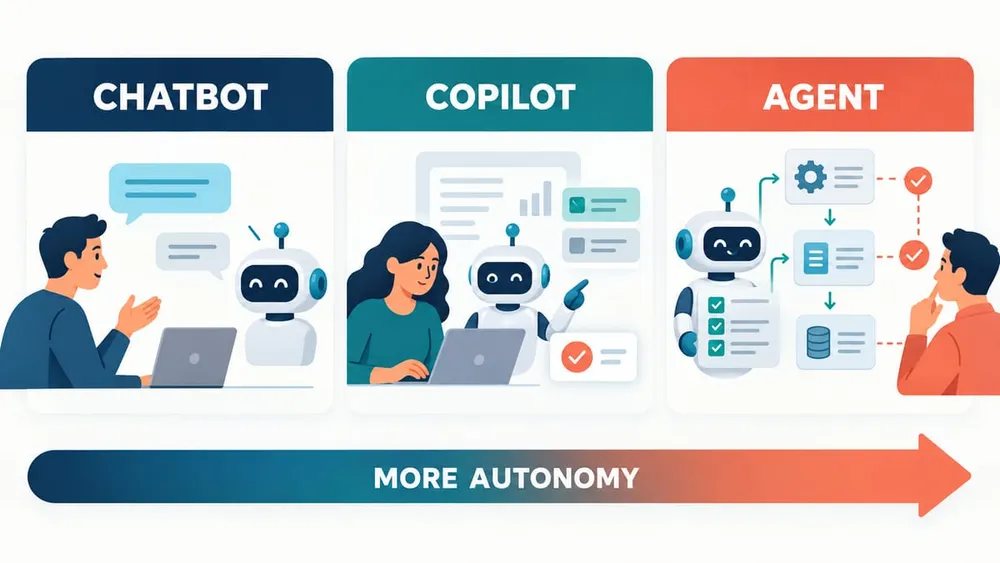
Chatbot: conversation is the product
A chatbot responds to messages. It may answer from a knowledge base, collect details or route a request. The user normally drives each turn, and the chatbot's main output is information or a conversational handoff.
Copilot: a person remains in the task
A copilot assists inside a human workflow. It may draft a reply, summarise a case, suggest code or prepare a report, but a person reviews the work and decides what happens next. Copilots are a strong starting point when judgement, accountability or customer impact makes full automation premature.
Agent: the model controls part of the workflow
An agent uses a model to decide which step or tool to use as it works toward a goal. OpenAI's practical guide describes a basic agent as a model, tools and instructions. Tools may retrieve data, update a system or delegate to another specialist.
That autonomy should be bounded. Give each tool a narrow purpose and least-privilege access. Separate read actions from changes. Require confirmation for financial, legal, customer-facing or difficult-to-reverse actions, and keep logs that show what the agent attempted and why.
Ordinary automation still matters
If a process is stable and every branch can be expressed as a clear rule, conventional workflow automation is often easier to test and operate. Agents add value when the work depends on unstructured information, contextual judgement or variable sequences. Combining the two is common: the agent interprets the request, while deterministic services enforce prices, permissions and state changes.
Choose by the required autonomy
- Use a chatbot for bounded questions and intake.
- Use a copilot when a person should remain the decision-maker.
- Use an agent when the system must choose and execute multiple steps within explicit limits.
- Use deterministic automation when the path and rules are already known.
For deeper architecture, see A2A vs MCP and Agentic Development with Humans in the Middle.
Chatbots, Copilots and AI Agents: Key Differences FAQs
Sources Checked
These primary sources were reviewed on 2026-09-17.